
A Filetta, of course !

The music of A Filetta is a journey… One might describe it as a demanding, bold form of contemporary polyphonic vocal music, rooted in a powerful oral tradition.
It began in 1978, when a group of very young people—some still in their teens—driven by a fierce determination to help safeguard an oral heritage that was in sharp decline, set out on a path… It has been a long journey, at times winding, yet marked by extraordinary discoveries and encounters. The singers themselves readily admit that the concept of the "encounter" is woven into their musical DNA. This likely explains why they chose not to confine their voyage to the boundaries of their own roots: while anchored in the tradition they inherited, they very quickly opened themselves up to other horizons—other territories, other disciplines, and other artists (performers, composers, stage directors, and choreographers).
The repertoire now produced by this vocal sextet serves as a faithful reflection of the path they have followed since the early 1980s: a trajectory that traces a movement originating within an oral tradition— ...centuries-old, yet asserting itself through the twists and turns of a style that is uninhibited and free from any filial obligations. Here, one finds a juxtaposition of sacred and secular songs with diverse influences: film scores by Bruno Coulais, compositions for choreography by Sidi Larbi Cherkaoui, excerpts from the chorus of an ancient tragedy, and even pieces from a requiem commissioned by the Saint-Denis Festival. Music in the service of a worldview that unequivocally rejects any retreat into identity-based insularity—a philosophy that might be summed up by this beautiful aphorism from René Char: "The purest harvests are sown in a soil that does not exist; they dispense with gratitude and owe everything only to the spring."
With yet forty-six years of history and a total of twenty-one albums to their name, A Filetta stands as the most magnificent of all Corsican polyphonic vocal groups.
Currently composed of six male voices, this ensemble—possessing an extraordinary level of creativity—passionately perpetuates the island’s oral tradition of sacred and secular singing. At the same time, they are widely recognized for their exploration of other realms of polyphonic vocal music, most notably through the creation of contemporary works.
The journey of A Filetta has taken over the past four decades is rich in diverse experiences and collaborations, spanning the worlds of theater, film scores, and stage productions.
You can follow the journey of this unique group on the
"Chronological
milestones" page,
consult their discography,
read reviews of their concerts,
explore
statements from the
members, find the lyrics to their
songs, stay updated on their
latest news,
and view photos...
Not to forget my book, "A Filetta - Tradition et ouverture" published by Editions Colonna.
But first, let’s hear some personal accounts from a few of
those who have
been won over by this singing.

Testimonials from enthusiasts
The first time I heard A Filetta,
it was about twenty-five years ago, on the soundtrack of a television
documentary about Corsica. The group had a unique sound; their
singing evoked a very particular emotion.
When they made one of their all-too-rare appearances in Paris, I went
to attend my first concert of theirs. It was, I believe, at the
church of Saint-Médard, on October 19, 1995. Ever since that concert—and the
one that followed
at the Conciergerie—I have been under their spell. And so has my entire family.
Anne-Marie, Claire,
Pierre, Pascale—we were all deeply moved, struck to the core by their singing.
We have attended numerous concerts
since that year,
1995—in the Paris region (at St-Louis-en-l'Île, the Théâtre de
la Ville, etc.), in Corsica of course, and even as far as Brittany, Lille, Belgium, and all the way to Germany—not only is the emotion always there, but it is becoming increasingly present.
These profound songs
can be harsh
or gentle, violent or tender, shouted or whispered. They are often
melancholic, yet not sad; solemn and fatalistic, but never
hopeless. In any case, they cannot fail to stir the emotions of the listener.
This singing resonates powerfully within you.
Leaving an A Filetta concert, one feels transfigured—moved and
happy
all at once. Since its formation in 1978, A Filetta has continuously
evolved, embracing openness while preserving the unique character
of the island’s vocal tradition. Sacred and secular songs,
inherited from the past, blend with original compositions—
testifying to a culture that is alive and in motion, rather than
frozen in time. The group is guided by a commitment to the spirit
of the tradition, which never serves to stifle their inspiration.
And then, there is Jean-Claude’s
astonishing voice—by turns caressing and harsh—and his face,
contorted with passion; both are truly fascinating. Part of what creates the magic of A
Filetta is the spiritual, emotional, and physical communion that
binds the
singers together and radiates from them.
Moreover, these immensely talented artists are
strikingly modest,
generous, and
humane.
This website is a modest attempt to thank them for those magical moments and to pay the tribute that is due to this major group which, as Gabriel-Xavier Culioli wrote in 1998, "left its mark on the end of this century and millennium through the purity of its art."
By what
mystery are people of such diverse origins, cultures, and
backgrounds all so deeply moved by the singing of A
Filetta?
There is, of course, the beauty of the voices. Yet other, equally beautiful
voices can leave us, as listeners, completely unmoved. Then there is the
way they
sing—the first words that come to mind are gentleness,
contemplation, and a keen sense of nuance. Even in forte
passages,
the singers never give the impression of straining their voices or
striving for mere
vocal display. "To express powerful things with tenderness, and tender
things with power"—
that is the lesson they have taken from the Georgian vocal tradition.
And it is true that all other Corsican groups—even those from the Balagne region,
who are close to them—do not leave the same impression. There is the
exceptional personality and power in the performance of Jean-Claude
Acquaviva, who experiences everything he sings with great intensity.
There is also the way the voices share the space, blending together or
standing out individually. There is the strength of the melodies and
harmonies in their original compositions; yet, even when they sing
traditional songs, one can sense a difference.
The secret of A Filetta may well lie in the deep, symbiotic bond among its members—the fact that the group functions as a single entity in which each individual plays their own part while also sharing in the roles of the others,
and where everyone surrenders to the collective without ever losing their own distinct personality.
Perhaps the most defining characteristic of A Filetta is its capacity to convey something truly powerful.
One does not emerge from an A Filetta concert unchanged; you are invigorated by the empathy the group fosters with its audience—a profound sense of communion, generosity, and sharing.
Yes, this singing opens the heart.
Jean-Claude Casanova

A sample (comment in german) :
And a short excerpt from Don Kent’s documentary :
I remember perfectly the day I first heard the voices of A Filetta. It was also the first time I had ever set foot on Corsican soil.
I had landed in Ajaccio and was headed to the Balagne region for a literary event. My friend Jérôme Ferrari had offered to drive me to the north of the island.
"Along the coastal road,"
he specified, "so that you can see the beauty of Corsica right from the start..." Ajaccio, Cargèse, Piana, Osani, Galeria—all the way to Lumio.
I had no idea the journey would be so long... that there would be so many twists and turns... or that it would be so incredibly beautiful. Nor did I suspect that, at some point, Jérôme would put on some music—
and that I would be instantly captivated by the voices I heard. It was A Filetta. The songs filled the car, draping themselves over the surrounding landscapes. *U lamentu du Ghjesù*. That song has remained
in my heart—or, perhaps I should say, it has settled deep into my bones.
What I felt, right from the start, was a sense of verticality. ...which the choir A Filetta creates. Nothing has an age anymore. Time opens up.
We are no longer in the present. Or rather, the present becomes like the past.
I did not perceive this at all as a song rooted in the past, but rather as one of those rare moments that art sometimes offers—moments that strip away our own era, leaving us face-to-face with the enduring nature of humanity.
Mothers have wept like this since the beginning of time. For centuries, people have sung of their sorrows, their anger, and their hopes in this very way.
To listen to A Filetta is to allow oneself to be traversed by time, becoming part of a long, unbroken chain of humanity.
<
In 2022, I had the opportunity to hear A Filetta during a concert in Paris with the ensemble Constantinople. This time, the emotion stemmed from a sense of horizontality—from the way A Filetta resonated with other geographies, embracing an infinitely vast landscape. I was struck by how harmoniously, intensely, and even joyfully these Corsican songs blended with other rhythms and cultures. Far from remaining confined to their own heritage-based roots, A Filetta shows no fear of the "elsewhere." What unfolded during this concert was the Mediterranean space, in all its profound diversity, stretching from the West to the East. The voices wove together as if by magic; the colors responded to one another, engaging in a true dialogue.
These two experiences, separated by a few years, help me understand what I love about A Filetta. Their songs are not, as it were, on a mission to safeguard a protected cultural enclave, wary of the outside world. Rather, it is an art that allows us—if only for a few fleeting moments—to touch the very heart of time. It is an art that can also open a gateway to the vast realm of otherness—like an eternal balcony from which one might contemplate the world, invite it in, and celebrate it.
And then, there is the beauty of the word itself: *chœur*—the choir. It reveals its full power during a concert. Men’s voices, gathered together, pressed close to one another—as if to keep each other warm—listening intently to one another. It is the perfect, living embodiment of brotherhood. The tenor voice leads the way, tracing arabesques of suffering or longing; the baritones provide a foundation, building the rhythm and broadening the song, lending it depth and a solid, enduring strength. And finally, the deep, resonant bass notes plumb the very depths. All of this conjures invisible structures before us—much like shamans who know the path to emotion, inviting us to follow, before slowly closing the circle once more. It is profoundly comforting that, in our day and age, A Filetta exists. That this voice from eternity finds its way to us. That, thanks to them, we remain in touch with the vast realms beyond what the eye can see—realms that reason cannot grasp, yet which give substance to life and move us to tears.
Laurent Gaudé
This beautiful text appears on the cover of I Balconi, the latest album by A Filetta. I have taken the liberty of reproducing it in its entirety, as it so perfectly echoes my own feelings.
"I had noticed on a flyer that A Filetta was performing at the Église des Billettes in Paris.
At 5 p.m., I joined the queue to enter the church. Most of the people waiting were not Corsican—you could tell by their speech and their appearance.
After a while, every seat was filled.
The lights went out.
And then, the magic of A Filetta began...
I didn't take note of any of the song titles. All I know is that, for an hour and a half, I was gripped by a profound emotion.
Make no mistake: Corsica was only part of the experience."
What permeated this sacred space was a gentle beauty—at times
melancholic, yet always full of hope. The brief remarks offered
to introduce the songs lacked the contrived or artificial quality
that such commentary might otherwise have had. The group’s leader
spoke to us
as if we were brothers and sisters, giving voice to the profound
nature of the island soul. There was no violence, no mere
folklore—only the
certainty of a destiny that, while sometimes painful, remains
rich with promise.
Never before had I heard such harmonics; never had I
grasped to what
extent simplicity can serve as a vessel for the divine. The group had to
return for two encores, so great and spontaneous was the
audience’s enthusiasm. I did
not dare to offer congratulations—or rather, thanks—to the
singers after the
performance. Beyond the joy they brought, they reaffirmed for me the
belief that,
even when everything seems difficult, there is still reason to hope. For all of this, for all those who applauded—
tears in their eyes—for
this culture without borders, devoid of hatred, and steeped in
fraternity...
THANK YOU
A Filetta..."
C.S.
Culioli
While vacationing in Calvi, we felt a desire
to discover "Corsican folklore," and, following a recommendation, we attended
a concert by "A Filetta" at the Basilica of Saint John the Baptist. It was
a
revelation! We discovered something far beyond mere "folklore"...
We witnessed and heard a group that left us dazzled
and spellbound!
Some time later, we had the good fortune to see "A Filetta" again in our own region, and we brought our 13-year-old daughter along. By the end of the concert, she was just as much of a fan as we were! Since then, like us, she attends as many of these fabulous evenings as our friends have to offer. Over time, we became devoted, ever-more-enthusiastic fans, and we travel all across France to follow them wherever they perform. The excitement grows greater each time, and we eagerly await their next show—because seeing and listening to them is a pleasure that feels brand new on every occasion. Thank you all—Jean-Claude, Paul, Jean, Maxime, José, and Jean-Luc. Thank you for everything you bring us through your singing, your talent, your kindness, and your humanity. Let’s just call it... pure happiness!!!!... Joëlle & Jean-Paul Pillot
They arrive in single file, dressed in dark colors—Jean, Jean-Claude, and Jean-Luc in shirts; Paul, José, and Max in sweaters. They arrange themselves in a semicircle facing the audience—from left to right: Max, José, Jean, Jean-Claude, Jean-Luc, and Paul. Jean-Claude sets the pitch, and the first song (most often "Makharia") rises up. One is immediately captivated by the fervor of the singers and the beauty of their voices: Jean-Claude’s voice—at once gentle, nasal, and husky; Max’s deep, agile voice; José’s gentle, virile voice; Jean’s dense, full voice; Jean-Luc’s pastoral voice; and Paul’s honeyed, warm, and enveloping voice. During the more dramatic songs, Jean-Claude’s face is infused with passion. You hold your breath, so completely absorbed in listening. What you feel goes far beyond mere sound; it is humanity—theirs and ours—the joy of belonging to the same community: "si di mè"—you are one of us. When the song ends, it brings both a release of held breath and a sense of frustration that the song has come to an end. There are no words to express what one feels; you have to experience it to understand it.
Anne Marie Casanova
I first arrived in Corsica in 1983; at the time, it certainly wasn’t an attraction to the local music that drew me there, but rather the fact that the island offered both sea and mountains in such close proximity. Captivated by the natural wonders found in the island’s mountains, I have returned every year since—though, initially, without ever imagining that the region might harbor a unique musical tradition. It was not until 1988 that this revelation occurred, through an introduction to the *paghjella*—a form of traditional singing— high in the Corsican mountains, courtesy of a group of singers from Ajaccio. They pointed me toward *A Filetta* as one of the region’s leading musical groups.
From that day on, I became obsessed with tracking down these songs— extraordinary for their ruggedness and controlled, raucous dissonances, and, to my mind, inextricably linked to the Corsican mountains. My wife and I began buying up large numbers of cassettes, and later CDs, by local singers—starting with I Muvrini, though we soon switched to A Filetta, a group we found more original and more faithful to their traditions. It was the time of "Machja n’Avemu Un’Antra" and by"A’u Visu di Tanti" which punctuated our holidays in Corsica with their traditional tunes of paghjelle and lamenti (Lamentu di Ghjesu) and their troubadour style pieces (Terra Brusgiata). Then came the time of visual discovery of their shows (seeing Jean-Claude in concert is always a great moment): the first à l’Haÿ-les-Roses, in the Paris region, where we live then, in 1992 à the release ofAb Eternu where I discovered this sublime piece that constitutes "Sumiglia", then others, later, when we were warned (rarely, as this group is so little mediatisé !) of their visit to Ile-de-France (Palais Royal, Saint-Denis, …).
From that point on, every one of their new records was a success— with special mention due to their collaboration with Bruno Coulais, which, for me, was a true blessing. The unique polyphonic style that emerged from this partnership—performed both a cappella and with instrumental accompaniment—has established this group as the most creative, original, and moving of all Corsican musical acts. They possess an unparalleled ability to produce work that is remarkably innovative and open-minded, while maintaining a profound connection to the ancestral roots of the island’s polyphonic tradition.
And that is how a "pinzutu" (non-Corsican) —someone with no prior knowledge or particular interest in music—became, in just a few years, an unconditional admirer of Corsican polyphony, as interpreted, enriched, and elevated to sublime heights by A Filetta!
Philippe Evrard
My
first encounter with A Filetta
Listening closely to A Filetta’s music evokes very intense emotions; it opens the heart. But to explain its effect would be like reducing a magnificent sunrise to nothing more than its physical properties.
I tried translating the lyrics and looked for information about the group, and I am so happy to have discovered "l'Invitu" and Jean-Claude Casanova.
My first in-person concert experience finally took place during the 18th Polyphonic Singing Encounters in Calvi. Unfortunately, there was too little of A Filetta for my liking (I only arrived on Thursday, so I missed "Medea"!), but it was an unforgettable event. I hope to see the group again in 2007 in Germany—that would be a great joy for me.
Ursula Glöckner

Return to Calvi of the banner "A Filetta Montrouge"
(Festival Chorus 2005)
A Testimony from Bruno Coulais
"The members of A Filetta are very different from one another, yet not a single shred of mediocrity can be found in any of them. While the Corsican tradition is ever-present, these singers are truly timeless. Their music transcends time; earthly moorings simply cease to exist. Their repertoire is a vessel constantly open to the world—never confined within the narrow bounds of a culture turned inward upon itself."
(Interview by Jean-Marc Raffaelli for Corse-Matin, edition of May 11, 2003).
Un« filu » di a filetta…
A Filettati aspetta
goccia à goccia
di a so terra
ràdica
cù a so forza
di u prufondu
à la filigrana
ti aspetta
a filetta
È ti canta
A Filetta
voce alzate di a terra (corsa)
di u prufondu
à l’alt’armunia
cù a ricchezza
di purezza
chì ti parla à l’arechja, à a pelle
chì ti tocc’à u fondu di u to core
è ti aspetta…
A
Filetta
chì ti aspetta
corpu interu
in pulifunia
chjama è carezza
rispondenu à u mondu
sin’à l’orizonti
in meludia
chì ti guidà
à a filetta (corsa)
È ùn ti scurdà
di a filetta
chì spunta
di a petra è di l’acqua
cù a speranza
di a memoria
cum’e rifugiu
pè oghje è dumane
è pè
mai ùn ti
scurdà
di a filetta…
Gerda-Marie Kühn
A FILETTA
ouA Dream Journey Among the Stars
Here I am, friends: I had vowed to bring you an extraordinary concert review for the new Earth year—mission accomplished!
To be honest, I hesitated for a moment, thinking you might not believe me—it’s just that incredible—but that flicker of doubt didn’t last long, given the undeniable fact that for those who adore the sublime *Fougère*, nothing is impossible, nothing is inconceivable: everything can be wildly improbable and yet as solid as granite!!!!
Let’s take a trip back to 2006!
For some time, a rumor had been growing—much like the one that once circulated about a potential, perhaps even possible, concert by *A Filetta* on Orion—a premonitory asterisk attached to the program (those in the know will understand)—only to fizzle out abruptly, almost without a trace.
And yet, this new whisper—announcing the concert on Andromeda—is something I turn over and over in my mind; I sense that I must not take it lightly.The duration of the journey demands taking a massive risk: although it is located within our Local Group, the distance between Andromeda and the Milky Way —where our Earth resides— is, according to the Hubble Telescope, nearly 2.9 million light-years (890,000 parsecs), or roughly 27 quintillion kilometers. It’s dizzying!
Given that my craft travels at 500,000 km/h, we’re talking about at least 12 billion years of my life for a round trip—a far cry from the usual little hops taken by a slightly unhinged fan (if you catch my drift)! But then again, when you love something, you don’t keep count!!!
And then, in memory of the man who was the love of my life— a sci-fi fan, mad about the book *Andromeda Nebula*— I must make the journey toward that galaxy of peace and tolerance, to see and hear them singing in that place of a radiant future described by Ivan Efremov. Is it a sign? This year, on planet Earth, Christmas and Eid fall close together for the first time in a very long while; surely there is no better place to dream of—a destination for sharing and hope—than Andromeda.
I feel, I know, that there is an urgent necessity to make the journey—the long, long journey toward happiness. It’s decided: I’m off! I cannot—I must not—let trivial excuses keep me from this rendezvous on Andromeda, however hypothetical it may still be! It’s like a mission!
First, a few photos as proof of my intergalactic journey: The first one shows a poster, spotted in passing as I left the Milky Way, attached to a celestial object drifting in an erratic orbit—what on earth possessed the concert organizer to forget to put one up back home? It’s what you might call a "love test": I don’t tell you a thing, and if you love me, you’ll eventually figure it out! And you all know that it works!
To the left, the Nebula is still 580 parsecs away from my sluggish yet valiant starship. Now I know what it means to have one’s head in the stars!
To the right, there are only 3 parsecs left to cover to reach the space where the concert is taking place (just follow the arrow!). I enter the heart of something beautiful—it’s indescribable—accompanied, as always when I go to see them, by that inexplicable emotion that disconnects me from everything and transports me to another world: here, in reality, I am in that "elsewhere" where time has no meaning!

So, here I am at the end of the road, in the Andromeda Nebula. The galaxy of hope!!!
Valérie is there—naturally, she’s there—reunions, kisses, warmth, joy; just like everywhere else, just like always! I sense an immense presence—impossible to see or quantify—and there’s no pushing, no shouting, just a kind of fraternal, hovering anticipation. Someone taps me on the shoulder; I turn around—it’s definitely not an Earthling, but oh, how beautiful they are!!! "We saw each other in Calvi last year," they say to me (or was it "she"?), "do you remember? Faiz Ali Faiz, Rassegna, Voce Ventu, Julia Sarr… it was brilliant, wasn’t it?" Stay cool, Françoise—everything is normal, everything is just fine! Well, you didn’t recognize him—it’s not easy, I know—but he was definitely there; after all, he’s showing you photos from the *Rencontres*, and you’ve got pretty much the same ones at home! There are no lights dimming here to signal their arrival—so they just show up, who knows how, since there isn’t even a curtain to pass through! They’re simply there, and that’s all that matters!

Seeing them at last, after such a long journey, their presence doesn’t feel the least bit out of place—they seem perfectly at home, wherever they are! They are perched on a wooden boat floating in the void; the ritual, magical arc they form—an unchanging configuration—is in place (Maxime, José, Ceccé, Jean, Jean-Claude, Jean-Luc, and Paul), surrounded by billions of stars, like a setting of diamond dust!
Already, I don’t want to leave!
Strangely enough (I’m a novice when it comes to celestial concerts!), every single spectator is facing them, at a distance of about five meters. And I mean *every* spectator: no matter where you happen to be—in front, behind, above, or below—they are, inexplicably, right in front of you, oriented the same way as each one of us! Furthermore, they have microphones—because the concert is being broadcast live to other galaxies in the Local Group—yet there is no sign of any sound reinforcement equipment whatsoever!
A giant hologram moves in every direction to present the program—and suddenly, I feel as though I am in the heart of the Citadel in Calvi, or somewhere else entirely, with them, with you! It would take so little to catch the scent of the "maquis"!
And so, in a silence
at the edge of the world,
They set the Universe ablaze.
More than Jean-Claude’s words, more than the haunting harmony of their voices and the beauty of their songs, more than their bodies brushing against one another, more than the tender and joyful bond that connects them—in this perpetual night, what moves me as never before is the shiver that runs through our "cosmos-polite" multitude—an intense, uncontrollable tremor passing through each of us as we hang on their every note. In this moment, they become the universal language that speaks of love, sharing, pain, anger, joy, memory, death, life, hope, the earth…—speaking to everyone, everywhere, with no intermediary. To sense, to feel, is to translate. A Filetta—Esperanto brought to life!
And then—having said it so often—I have now reached a certainty, deep among the stars: if angels sing, they have the voice of Paul! Sublime!
Here, the tears born of deep emotion do not roll down one’s cheeks; instead, they take flight into space as countless streams—filaments of liquid happiness, of salty emotion—winding their way among the celestial bodies. And what if the traces that astronomers seek on distant planets were, in reality, the indestructible imprints of the polyphonic joys we experienced while listening to A Filetta? Perhaps, one day, someone will bring my tears back to Earth!
I no longer know how long we remained anchored to them in this way, but when the concert finally came to an end, we found ourselves unable to cast off the moorings.
It’s the same everywhere and always!I went to kiss them—it’s my own personal ritual—and we were so happy to be together here! Seeing them so radiant, despite their fatigue, I realized that we had truly risen to the level of their offerings; at every moment, they could feel our communion with them! A magical moment!
Leaving them will always be a painful wrench—a child’s sorrow—tempered by the sweetness of the joys we experienced, and full of the promise of those yet to come!
I said goodbye to the galactic throng of new, unconditional lovers of La Fougère: each of us knows full well that this is a phenomenon one simply cannot resist! See you soon, on my home ground!
I am setting off; the road is long, but—thanks to the magic of A Filetta—I am intoxicated by the happiness they offered me, the happiness we shared; intoxicated, and wonderfully at peace.
I am thinking of these lines by Antonio Machado:
« I dreamed last night— oh, marvelous error— that bees within my heart were turning my failures into honey.
Maxime, José, Ceccé, Jean, Jean-Claude, Jean-Luc, Paul, you are my bees !
Pace è salute à tutti !!!
Françoise Coulomb, Marseille, January 21, 2007
I’ll say it:
even though I’m not Corsican and don’t understand the language,
listening to their songs gives me goosebumps...
Especially during the 4:10 duration of "A Paghjella di l'impicatti,"
not to mention the dramatic and
sublime "Medea"...
I think it all started with "Winged Migration" (*Le Peuple migrateur*).
Thank God, A Filetta avoids the trap of
commercial pop music. Their sacred songs are a tragic jewel of purity.
Listening to them makes the hair on my arms stand up—it’s truly
stunning, and that’s exactly how it should be!
It was thanks to television that I discovered A Filetta. They’ve
never performed a concert in my region, but I have all their CDs
on
my Mac.
Danièle Leroy
I believe it was in
1993.
Thanks to a
subscription at
the cultural center in Le Perreux—which just goes to show that subscriptions can be a good thing—
I attended
my first A Filetta concert. At the time, while my
Corsican roots made me somewhat inclined to listen to Antoine Ciosi, Petru
Guelfucci,
or the Nouvelles Polyphonies Corses, I must admit I wasn’t
all that hooked. I enjoyed those rich, melodic voices, the
rugged quality of the singing, and the strong sense of identity, but
something—hard to define—kept me from fully
embracing the music. So, I wasn’t expecting anything in particular from this
A Filetta concert, other than the pleasure of being there and
hearing these songs resonate within a church.
And it was a revelation!
From the very first songs — austere as they were (this was the era of Ab eternu)— something began to happen.
A kind of fervor, a profound sense of communion, gradually took hold of the entire audience. With the song "Ghmerto", things reached another level. As the piece built in a crescendo, the singers were able to reveal the full extent of their talent, evoking an extraordinary depth of emotion.
Then
came the Lamentu di Ghjesù, delivered with
dramatic intensity, beauty, and a
deeply moving sincerity. Against my will, tears streamed down my cheeks.
Real tears—
tears of pure emotion. Tears of happiness. A shiver ran through my
entire body; my breath caught, and I found myself holding it involuntarily
as I listened to this gem.
And finally, to conclude, Sumiglia. This pearl—this
masterpiece—which A Filetta continues to refine with every concert,
always with a sincerity that feels fresh and renewed.
Ever since, I have tried not to miss a single concert that comes to proximity,
or even traveling to rediscover that unique emotion.
As chance would have it, I had the opportunity to see and
hear
Medea, directed by Jean-Yves Lazennec at the
"Printemps des
Comédiens" festival in Montpellier in 1997. It was a chance
to appreciate how A Filetta knows how to take risks, embrace
challenges, and—above all—succeed at them.
Then came other concerts, new creations—each one more beautiful than the last. The *Requiem*, collaborations with Bruno Coulais, Sidi Larbi Cherkaoui, and Orlando Forioso—"Si di mè", "Medea" once again…
Meeting each member of the group was also essential for me. It could have been a disappointment—encountering people entirely consumed by their own art—but quite the opposite:
I discovered individuals who were remarkably humble, sensitive, and passionate—profoundly human.
And it is this extraordinary coherence—between who they are and what they do, between what they create and what they project, between the mastery of their voices and the beauty of their songs,
between the unity of the group and their ability to share what they experience—it is this very coherence that makes their concerts truly magical and unique.
Pierre Casanova
My name is Julien Gay. I lived in L'Île-Rousse, Corsica, from the age of 5 until I was 16. When I was about 13, I was fortunate enough to meet the group A Filetta through the brothers of Saint John at the convent of Corbara—specifically Brother Drago and Jean-Baptiste. The brothers invited me to join them at Le Carubbu in Lumio; the group had offered to teach them how to sing polyphonic music, and I was part of it! What wonderful times those were—I learned so much from Jean-Claude, Jean, Pierre, Paul, and the others. I later attended the classes they held on Sundays. In the courtyard of my middle school, my friends and I began singing together in small groups. We even took part in the "Valle Voce" competition, and I was lucky enough to perform as an opening act for the group in L'Île-Rousse. Even though I am not Corsican, I believe this place will always be my home. It is deeply rooted within me. The group taught me a great deal for my musical career, and their advice stays with me to this day. I continue— incidentally— to sing Corsican, French, and Italian songs as an amateur. I have been living in Saint-Brieuc for over a year, and I am currently working on a CD of French songs with a local singer-songwriter. So, I went to Lorient to see them perform. As always, I was glued to my seat the moment the group began to sing—it really hit me in the gut! I felt like crying, as it had been more than 10 years since I last heard them. My wife, who only knew them through my CDs, really enjoyed it— though I personally believe that this type of singing requires natural acoustics, not microphones! I was surprised by the audience’s lukewarm applause, which included only two polite encores. In fact, the people sitting next to me had clearly had enough—at one point, they remarked, "They aren't going to keep calling them back all night long!" That took me aback, but then again, it takes all kinds to make a world! Afterward, I went to see Valérie and the other band members. Their welcome was so warm that it felt as if I had only just parted ways with them the day before! I asked if I could join them in singing a "paghjella", and they agreed. Céccè and Jean-Luc sang along with me — I took the "siconda" part — while Jean and Paul looked on with kind, encouraging eyes. It was such a wonderful treat! Julien Gay
Die korsische Musik durch Zufall entdecken.
In diese faszinierende, ungewöhnliche, archaisch anmutende Klangwelt, ohne jegliche Vorwarnung hinein zu stolpern, ist wohl die schönste Art diese Musik kennen zu lernen. Völlig unvorbereitet und ahnungslos bin ich in den Wirbel der korsischen Gesänge geraten und wurde von einer emotionsgeladenen Klangwelle überrollt. Und das noch dazu, von "A Filetta". Die Gruppe, mit einem der charismatischsten Musiker den ich je erlebt habe.
Jean-Claude Acquaviva hat eine Bühnenpräsenz die Seinesgleichen sucht. Völlig in sich gekehrt, in seine Musik, abgegrenzt in seiner Welt des Klanges - und doch mitten im Publikum. Man spürt Ihn förmlich bis in den letzten Winkel; er ist bei jedem einzelnen seiner Zuhörer und bleibt trotzdem unberührbar in seinem intimen Halbkreis der Sänger.
Fasziniert und bewegt werde ich diese erste Begegnung mit den "Polyphonies Corses" in ewiger Erinnerung behalten.Discovering Corsican music by chance.
Stumbling into this fascinating, unusual, and seemingly archaic sonic world—without any prior warning—is perhaps the most beautiful way to discover this music. Completely unprepared and unsuspecting, I found myself caught in a whirlwind of Corsican singing, swept away by an emotionally charged wave of sound. And this, no less, by the group "A Filetta"—a collective featuring one of the most charismatic musicians I have ever encountered.
Jean-Claude Acquaviva possesses a stage presence that is truly unrivaled. He appears entirely turned inward, absorbed in his music, sequestered within his own world of sound—yet, at the same time, he is right there among the audience. You can feel his presence in every corner of the room; he reaches every single listener, while remaining untouchable within the intimate semicircle of his fellow singers.
Fascinated and deeply moved, I will forever cherish the memory of this first encounter with the "Polyphonies Corses."
Margarethe Hlawa
Margarethe
is a young austrian musicianwho studies the Corsican singing.
U cuncertu di sabbatu scorsu (u 17mu di nuvembre pè u 2007) accantu à Bordeu (Bordeaux) era un incantu, incù 'ssi belli ritimi lenti chi' danu u tempu di rifiatà; e so radiche so' fonde e i so' soni dolci, lindi e à le volte strane aprenu i purtelli di i nostri cori sopra u Mediterranniu !
Ghjuvan Petru Battestini
For A Filetta’s Dutch tour in December 2007,
Jean-Claude asked me if I would be willing to translate and read aloud on stage
the
introductions between each "set" of songs. It was a great honor for me, and also
a source of great joy, to finally be able to do something for them...
A week has passed since the concerts, and we miss these truly
endearing people. We were deeply touched by their
kindness and their simplicity. Having shared their
private world for three days was a wonderful experience for us. They welcomed us and
opened their hearts to us. We truly consider them friends...
Laurent Lohez (Tra Noi)
And, in conclusion, the tribute from the Georgians (Tbilisi, June 2011):

A Filetta on the program Mezzo Voce in September 2008 :
Press excerpts
"Enthralling as the night, profound as hope." — L’Express
"The very best in polyphony." — Le Monde de la Musique
"The group takes us somewhere between the devotion of church hymns and the sensuality of 'medieval' madrigals." — Télérama
"Born 25 years ago in Balagne, A Filetta has become one of the premier ensembles representing Corsican heritage—thanks to their tenacity, their mastery of Corsican polyphony, and, above all, their capacity for renewal and their willingness to open the island’s repertoire to influences from further afield..." — Libération
"A Filetta: A Pure Marvel." — Pariscope
"Never before have polyphonic songs achieved such success." Le
Figaro
"All the
traditions of a Mediterranean open to a multitude
of influences."
Musique Hebdo
"Voices from before the spoken word—enough
to leave one on one's knees, gazing toward the heavens." Aden
"The most prestigious Corsican
polyphonic ensemble, once again reaching the sublime." L'Hebdo
"This is one of the
most sumptuous Corsican polyphonic groups one could ever hope to hear...
A Filetta has managed—without ever compromising its own identity—to open up this ancient art form to
other modes of expression, notably through its work on film scores
with composer Bruno Coulais, who also co-produced
their remarkable album 'Si di mè' (Virgin)." LE NOUVEL OBSERVATEUR
"Far from fixing the score in a rigid state, the group’s polyphony draws its strength from the vitality and emotion evoked by the way each member crafts the timbre of his own voice. Guttural sounds, the nasal musicality of certain syllables, the blending of intonations… The entire artistry of the singers of A Filetta is amplified by a complex harmony—a technique for which they alone hold the secret." L'Humanité
"Words fail
to describe
the emotion felt. Six or seven voices, like a compact block of sound—
whole,
solid, yet as supple as malleable clay. A sound that
shifts and reshapes itself through the harmonies that knead it from
within. But what is most striking is that Jean-Claude Acquaviva’s
ensemble always sings with great nuance, setting itself apart
from all those
groups that so often tend to rely on sheer force. The
result—dazzling in its beauty—leaves you breathless,
with a lump in your throat… No one, to my knowledge,
sings like this today; and for an emotion such as this, one must say thank you…
"
Marc Robine /
Chorus –
Les Cahiers de la Chanson
"A performance for eleven dancers, seven singers, and one musician, in which Sidi Larbi Cherkaoui returns to a visual restraint—a choreographic language centered on the dancing body, with an intense focus on movement and rhythm. The piece is further elevated by the staggering majesty of the vocals from the Corsican ensemble A Filetta and Lebanese singer Fadia Tomb El-Hage. (...) The seven voices fill the space much like air gently inflating a balloon—a subtle, penetrating presence with a clear polyphonic texture and an elastic expansiveness that, in a single sweeping gesture, embraces both the traditional Corsican and Eastern repertoires of the performers." — Le Monde
"A Filetta: Open-Ended Song." "Since 1978, the seven Corsican singers of the polyphonic group A Filetta have pursued a demanding yet open path, bridging an ageless oral culture with written traditions, all while reaching out to engage with the wider world." — Mondomix
"Independent and creative, A Filetta reaffirms its refusal to be confined to the reductive role of ‘guardians of the temple’—mere custodians of a static, insular vocal art form—choosing instead to breathe life into an inspired ensemble that, while firmly rooted in its heritage..." "...his native land, but rather to better catch the scent on the wind, or—as is the case today—to gaze toward the sky, much like the fern from which he takes his name…" La Terrasse
A report for a TV Suisse Romande program : "Faut pas croire" : "A Filetta : chants d'une terre", to discover here :
https://www.rts.ch/video/emissions/religion/faut-pas-croire/3186564-a-filetta-l-ame-d-une-terre.html
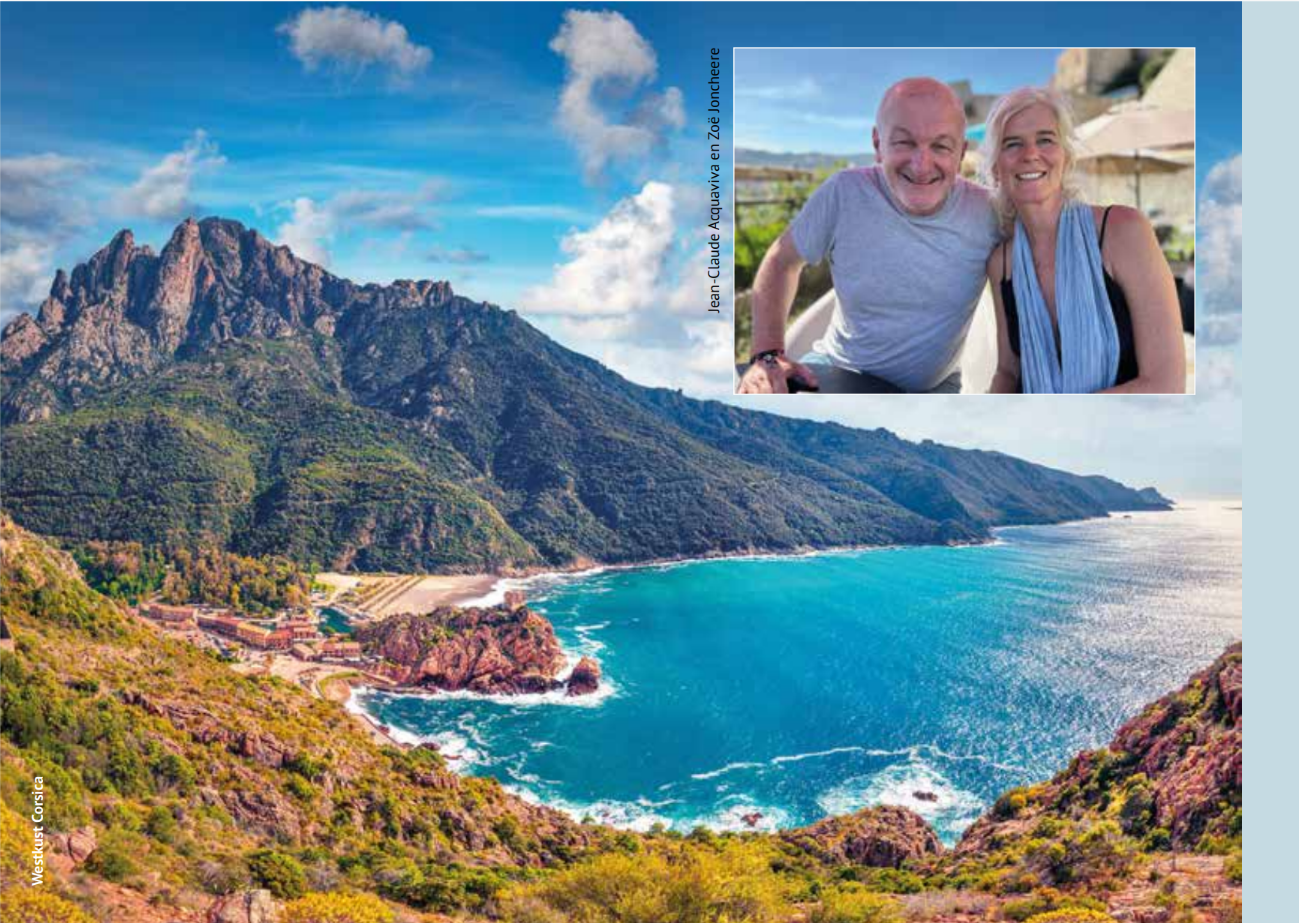
On November 20, 2025, I received an email from Bart Hommersen, creator of an independent Dutch magazine called Vruchtbare Aarde, which he has been self-publishing for about thirty years. Bart mentioned that the upcoming issue would feature an article by Zoe Joncheere, who had traveled to Calvi to attend the Rencontres de Chants Polyphoniques (Polyphonic Singing Encounters)—a trip prompted by her having been moved to tears, shortly before, upon first hearing the voice of Jean-Claude Acquaviva. While at the event, she got in touch with him and was able to conduct an interview.
Bart asked for my permission to use my photographs to illustrate the piece, a request I was, of course, happy to grant.
Here is the article:
Zoë Joncheere’s Italian tears lead her toward Corsican song
"I’ve fallen in love," wrote Zoë Joncheere from the Italian region of Piedmont, where she has been living for the past year.
She fell in love with the voices of Corsican men—voices she first encountered at home when, quite by chance, they began to emanate from her speakers. "Their music touches me so deeply that I’d like to write an article about it.
In truth, I would leave for Corsica tomorrow." Here is the account of her musical pilgrimage.
Corsican polyphony
I have always loved the French language, and France itself. But perhaps today, I love Italian and Italy even more—the kindness of people in the countryside, the glorious, weathered architecture of the cities. To me, French is like a colorful, artistic, and slightly eccentric grandmother, whose home is filled with books, philosophical conversations, and the aroma of something simmering in the oven. Italian, by contrast, is the language of a friend who never ceases to surprise me—weaving together simple, clear sounds to create not just music, but a language that actually says something. And yes, he knows how to cook, too.
I once had a second home in France. Italy, however, is the country where I eventually settled—a year ago now. I love both countries, their respective languages, and their people. Yet, the two worlds never seem to cross paths. In France, I never come across Italians; in Italy, I don’t see any French people. Perhaps they love their own country and their own language too much. Perhaps they feel uncomfortable in each other’s company.
Is there, then, no common ground? No place where "the grandmother" and "the friend" might meet? Such a place does, in fact, exist—and it is only a ferry ride away from where I live. That place is called Corsica.
Music and Tears
Music and tears were the tangible catalysts for my departure to Corsica in September. Underlying this was my need to follow my heart whenever it is stirred. And my heart was stirred one morning when we began the day with half an hour of free movement set to music. The playlists that accompany us usually emerge organically, nurtured by other playlists and recommendations from Spotify—which, it seems, is starting to get to know me quite well.
Then, one morning, the voices of the Corsican men from the group *A Filetta* suddenly rang out in our large, open-air meditation hall. The first time I heard them, I found them unusual. The second time, even more so. And by the third time, tears began to stream down my cheeks. These voices touched me to the very core of my heart—a heart that perhaps also longed to travel again, to spread its wings. It was as if I were being called by Corsica.
It was, above all, one particular voice—with its urgent, raw quality—that I felt a desire to get to know and understand better; a month later, the opportunity arose.
Festival
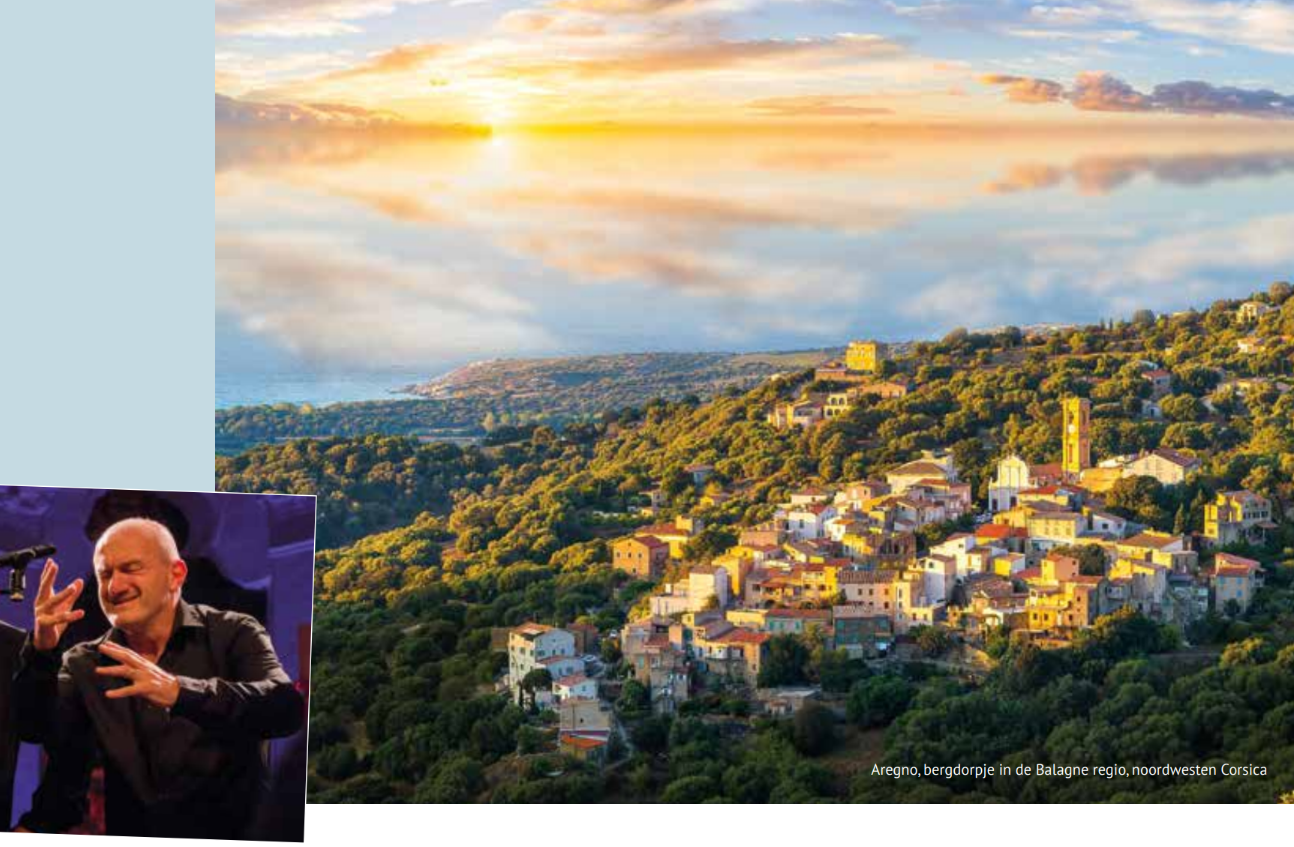
I find myself at the Rencontres des Chants Polyphoniques (Polyphonic Singing Encounters), an annual festival held in Calvi, a small coastal town in the Balagne region—the stronghold of *A Filetta*. The singers perform a concert and then share the stage with other voices from all over the world.
As a visitor, you get to combine the *art de vivre*—the sea, beautiful weather, and fine food—with one, two, or even three concerts a day. The evening concert, at 9:30 p.m., takes place inside the cathedral—always opening with a performance by A Filetta themselves, before giving way to guest ensembles ranging from the highly traditional to the contemporary; musicians who are formally trained or self-taught; performing with or without sheet music, with repertoires that are sacred or secular, often serious, and at times playful.
As the opening concert ends, the cathedral empties, and I manage to approach Jean-Claude Acquaviva—the man whose voice brought me to tears. I tell him as much and ask if he might have time to talk in the coming days. He is affable and open. Two days later, I am invited to the artists’ village. It’s as simple as that. I hadn’t planned anything, written ahead, or called to set up an appointment; I prefer to let things unfold naturally.
Before our meeting, I have the chance to hear A Filetta perform twice in the cathedral. The seven men, all dressed in black, stand close together in a semicircle. Some are older, others younger—one is even participating for the first time. Some of the singers possess a gentle, understated power, while others are more expressive.
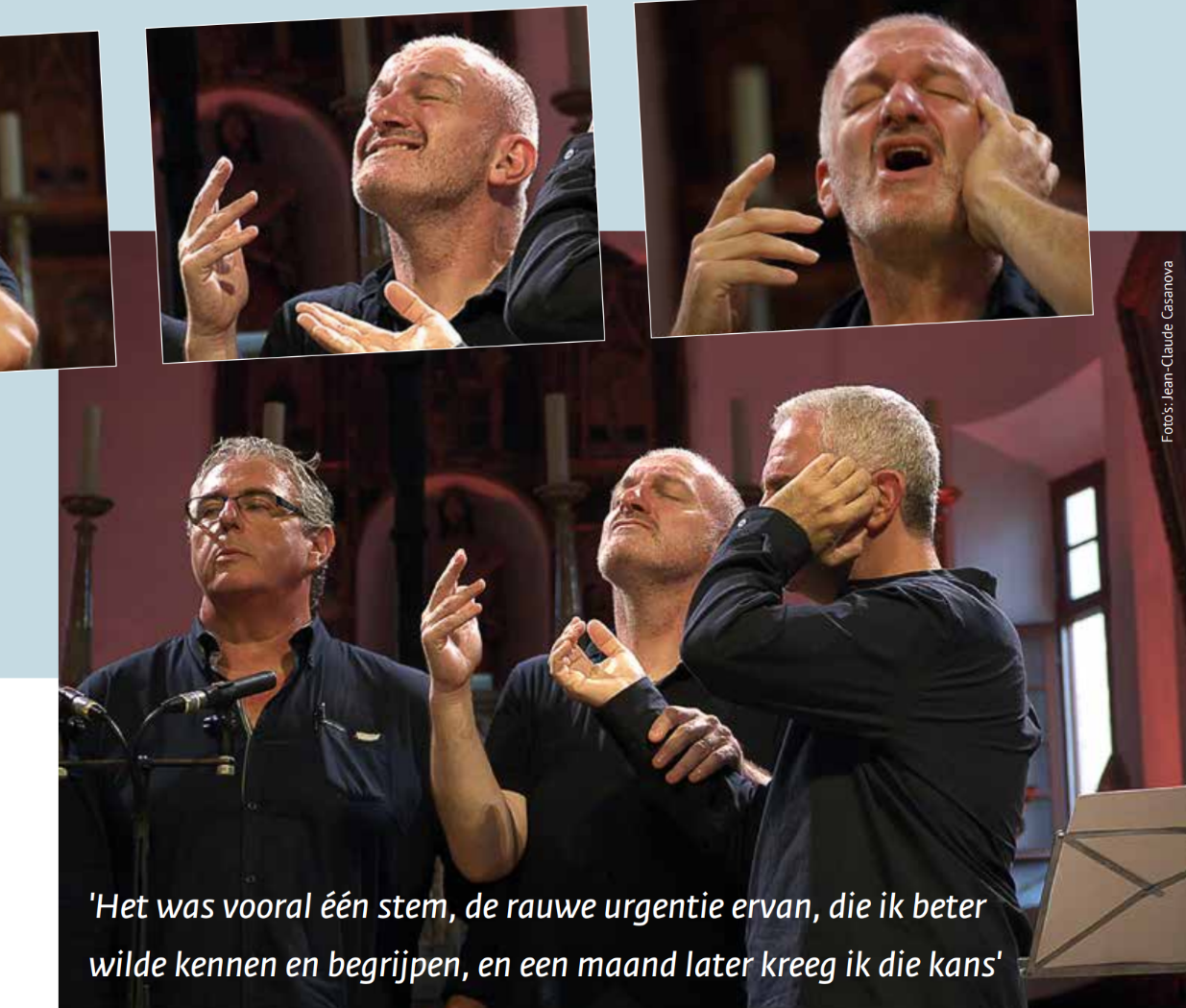
When Jean-Claude begins to sing, it is as if he shifts into another dimension. His face tightens into a grimace of urgency. His eyes close, and he leans slightly forward, his head tilted upward. One hand rests against his ear, while the other conducts.
Heritage
When we sit down face-to-face, I ask the most obvious question: how did A Filetta come to be? Jean-Claude explains how it all began here, in the Balagne region, nearly fifty years ago. It started with an amateur singer who brought a few voices together. Jean-Claude was thirteen at the time; the others were a little older. The new ensemble aimed to help preserve the Corsican polyphonic heritage, he explains. "That was our primary reason for existing when we started, but very quickly, collaborations emerged with groups from Japan, Georgia, Lebanon, and Egypt—as well as with jazz and classical musicians—and we have also worked for cinema." In the Netherlands, A Filetta collaborated with the Nederlands Blazersensemble in Amsterdam.
"Tradition is beautiful, but so is novelty. We are constantly evolving. Traditional Corsican polyphony is sung in three parts; we, however, are five, six, or seven. I like to use the metaphor of a sieve. We pour things into it—some pass through, but that’s perfectly fine. It creates space for new developments."
When you sing, something seems to transform within you. I’ve wondered: is it you who is singing, or is it something else singing through you? (*) Primo Levi (1919–1987) was an Italian-Jewish writer, chemist, and Holocaust survivor. He joined a group of anti-fascist partisans, was arrested in 1944, and deported to Auschwitz. In his best-known work, *If This Is a Man*, he describes his experience in the camp with remarkable precision, refusing to dehumanize anyone. Even in the guards and tormentors, he sought to continue seeing human beings. Throughout his life, he struggled with trauma and survivor’s guilt.
As he speaks, Jean-Claude occasionally glances around at the bustle of the artists’ village, yet his attention remains firmly fixed on the conversation. "Sometimes, we work for a very long time—we might sing a passage thirty times over. Or perhaps we explore a dissonance, a tension within the resonance. And then, suddenly, everything falls into alignment, and it happens." For me, yesterday’s concert was magical. I was deeply moved—even more so than the evening before. Did you experience it the same way? A Filetta was performing with a new singer. It struck me that he sings with the same sense of urgency I hear in your own voice. He also played a significant role. You are a highly engaged artist. Your music reveals how deeply you are affected by both the beauty and the cruelty of the world. Do you consider yourself an artist-activist, or are you simply letting your heart speak? Creating connections—this is a recurring theme for Jean-Claude Acquaviva. I also notice that he often cups his hand around his ear during concerts. "We form a shell with our hand to direct the sound back to our ear," he explains. "It’s a common practice in traditional music. You can hear your own voice better, as well as the voices of others. And that is essential for singing together—for establishing a connection." To conclude, I want to ask Jean-Claude about the Corsican language. At every concert, I notice that he addresses the audience in Corsican first, then repeats what he has said in French. Un grand merci à Bart Hommersen Posted on September 15th, 2015 by Songlines Magazine.
Andrew McGregor takes a look at the Corsican polyphonic ensemble keeping this ancient form of singing alive A Filetta will perform alonside Rustavi Ensemble on October 13 at the Barbican Centre. Spot-lit in the cool shadows of a small church in Corsica, six men stand in a semi-circle, eyes half-closed, hands cupped over ears, voices keening, pirouetting, soaring around one another, raising hairs on the back of your neck with ringing sincerity and raw passion. This is the timeless sound of Corsican polyphony, voices that seem ‘to issue from the birthpangs of the world’ according to the island’s biographer Dorothy Carrington. And to get here you’ve probably followed one of the posters on a lamppost, phone box, or a tree that guide you towards Corsica’s ancient music. This is A Filetta, performing the traditional three-part pulifunie (polyphony) that faced extinction until the wave of Corsican nationalism in the 1970s that led to the riacquistu – the reacquisition of music and language that ignited the cultural renaissance of the 80s and 90s. A Filetta are named after the Corsican fern, so well-embedded that it’s almost impossible to uproot. They were formed in 1978 by a schoolteacher and a beekeeper in Balagne in the north of the island. The ensemble’s early repertoire of songs with guitar included just a handful of polyphonic compositions. But the characterful voice and musical personality of Jean-Claude Acquaviva have been the key to their sound on a 35-year journey from nationalist fundraising concerts to major world music festivals, constantly revitalising and renewing their musical traditions through their own compositions and collaborations. The ensemble developed a musical double life; it was already a fixture at the Easter Passions in Calenzana, and Acquaviva began stretching his compositional muscles in pieces for the Calvi Passion. By the late 80s A Filetta were placing liturgical styles from these village confraternities alongside the secular paghjella, the traditional laments and ballads of love and loss sung in three parts. A key example became their calling card: ‘A Paghjella di l’Impiccati’ (The Ballad of the Hanged Man), a tale of Corsican resistance to the French army in the 1770s. Acquaviva’s version began as a chanson, then freed itself from guitars as a capella polyphony of searing power. You can hear its evolution across A Filetta’s recordings, and the vocal style that’s come to define the ensemble’s sound – mellower, more sophisticated harmonising than the amateur ensembles, wonderfully fluid ornamentation, and an emotional and dynamic range that’s astonishingly affecting. In 1989 A Filetta helped organise the first Rencontres de Chants Polyphoniques in Calvi, an international festival of polyphony that throws open the doors to vocal ensembles from all over the world, and simultaneously introduces them to Corsica’s vocal heritage. Collaborations followed, with Georgian Voices and maloya singer Danyèl Waro. Acquaviva’s musical ideas were becoming more adventurous: his compositions for a theatre performance of Medea led to a series of collaborations with French film composer Bruno Coulais, and experimental combinations with Tibetan music, and even rap. It’s given A Filetta new musical confidence as well as a new toolkit; from being part of the island’s aural tradition, they now read music, and learn and compose in the digital environment. Acquaviva’s recent Di Corsica Riposu, Requiem Pour Deux Regards explores the tension between ancient and modern that keeps the group’s musical batteries charged, drawing inspiration from other cultures as they reconnect with Corsican laments for the dead. Two recent excursions have been into the world of theatre and dance with Moroccan-Belgian choreographer Sidi Larbi Cherkaoui. Apocrifu (2007) explores the idea of sacred texts and books with three dancers and A Filetta sharing the stage. And Puz/zle, created for the Avignon Festival in 2012, brought the Corsicans together with Lebanese singer Fadia Tomb El-Hage and has been reworked as a concert piece. Cherkaoui describes A Filetta as a “polyphonic group that sing with a single voice.” So A Filetta not only represent the best of Corsica’s riacquistu on a world stage, but they have become a distinctive voice on the contemporary theatre scene. For Acquaviva it’s gone far beyond simplistic reverence for tradition: “Rather than a question of fidelity to one’s roots, it’s a question of having roots. Once you have them, you don’t need to prove that you are faithful to them.” BEST ALBUMS
(Virgin France, 2002) Intantu is perhaps A Filetta’s finest studio album, and it includes the most spine-tingling account of ‘A Paghjella di l’Impiccati’ (The Ballad of the Hanged Man). (Olivi Music, 1996) Award-winning recording of Christ’s Passion, the music performed during Holy Week in Calvi in the 90s. (Virgin France, 2003) Featuring arrangements and orchestrations by film composer, Bruno Coulais, who is a key collaborator. (Deda, 2011) Jean-Claude Acquaviva’s most ambitious composition to date. Here Corsican laments for the dead meet Georgian drones and bandoneón. Reviewed in #80. (ECM, 2011) Sketches of Corsica in which A Filetta’s intense harmonies meet the trumpet of Paolo Fresu and bandoneón of Daniele di Bonaventura. Reviewed in #77. This article originally appeared in Songlines #102 (Aug/Sep 2014). Photo by Didier D Daarwin
Every year,
across the globe, between 40,000 and 45,000
people attend concerts by A Filetta. These concerts are
listed on the "agenda" page (available here).
You can also
visit the group's official page.
Enfin en ligne, les photos prises au fil des concerts d'A Filetta
auxquels il m'a été donné d'assister.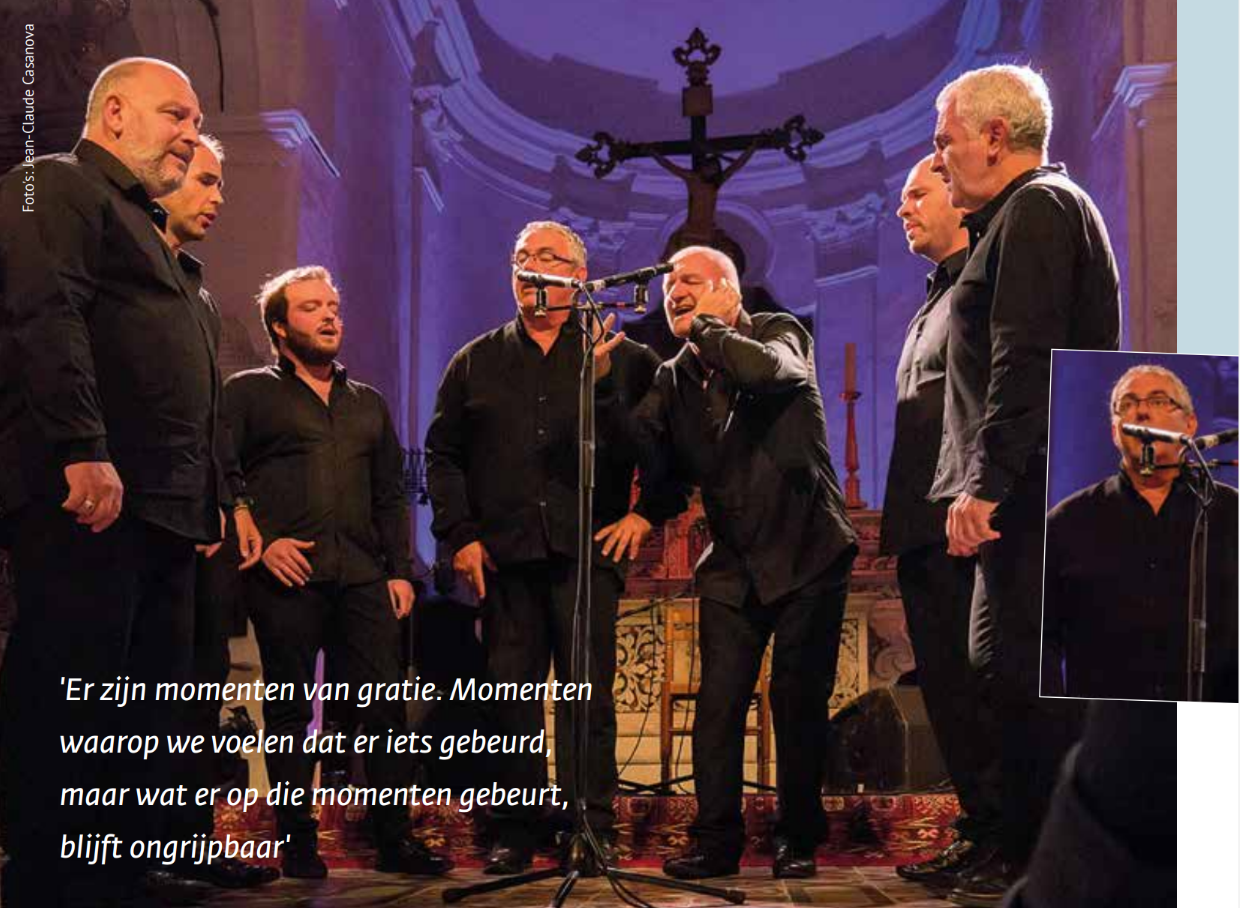
What do we know about the origins of traditional Corsican polyphony?
"Not much. The further back you go, the harder it is to trace. It is an oral tradition. Even today, it is not written down; it is passed on *a bocca* (*bocca* means ‘mouth’ in both Corsican and Italian). There are similarities to other singing traditions—in Sardinia, Georgia, Albania, northern Greece, Bulgaria, the Apulia region—but there are also characteristics unique to the Corsican tradition. For instance, the use of three voices. And it is always sung at full volume; there are no variations in loudness. There is no fixed rhythm, either—it is music without set measures. You cannot simply wait for a specific beat to strike a note; the rhythm is dictated by the words themselves. Consequently, singing a *paghjella* requires an immense amount of work and fine-tuning."
Is it, then, essential for the singers to know each other well?
"Very important. Traditionally, the singers were men who were already connected in their daily lives—colleagues, or brothers. When we sing, we stand very close together; sometimes we even touch."
Urgency
"I couldn’t say. When we sing, there is something that eludes us—something that transcends us. Among ourselves, we always say that we are trying to find a perfect balance, even while knowing that this perfection is an illusion. And yet, we are constantly searching for it. That is what our music is about. When we are on stage, we try, again and again. We search, and search, and search…"
Across from me, Jean-Claude closes his eyes; I recognize that look of urgent intensity I’ve seen on stage. His head sways slightly, as if he were searching for something. "We must devote ourselves entirely to what we are doing," he says. "And, at the same time, let go. Otherwise, it doesn’t work. If each person focuses solely on their own voice, there is no fusion. And then—it simply doesn’t happen! For it to happen, you need devotion—listening, while simultaneously letting go."
Is that how you approach perfection?
"Exactly! That’s precisely it. We approach it, but we never quite reach it."
Never, really?
"There are moments of… let’s call it grace. Moments where we feel that ‘something’ is taking place. But that something is elusive. You can’t quite put your finger on it." And these remain very brief moments."
Could these moments be described as mystical?
"Yes, at times it can feel that way." He recounts, for instance, how the group worked with texts drawn from the writings of the Italian-Jewish author Primo Levi. "And there, naturally, something happens. We set passages from *If This Is a Man* (*) to music. You cannot sing such texts without being fully present. You have to sing them completely, with total commitment—not just physically, but by listening intently to one another."
And can that moment be recaptured later?
"Ah, no—unfortunately not. We aren’t always able to find it again." It survives only in our memory. Thanks to these experiences, we now know what is possible."
Magical
"Yes, it is important to integrate a new singer, but it’s not easy. As a soloist, he has followed his own path; he has his own character, which he must preserve. Yet, at the same time, his voice has to harmonize with the group. To achieve this, you first have to give him a prominent role—you have to, in a sense, throw him into the lion’s den."
And, in my view, it worked remarkably well. The previous evening, I heard A Filetta perform a traditional paghjella featuring the new singer alongside two other men—a three-part vocal arrangement, just as the paghjella was originally sung. Later, the full ensemble of A Filetta performed a section of a Requiem, in which I frequently heard the word lacrime (tears). Long, sustained notes alternated with ornaments and glissandi. At times, brief dissonances made the music even more poignant.
Commitment
"I try to say what I have to say. I don’t want to be an activist who lectures others, but certain things trouble me, and I cannot remain silent. As an artist, I have access to an audience; if I stay quiet, I become complicit. If I say nothing about what is wrong in the world, I feel I am failing to fulfill my role. My music cannot be separated from the values we uphold."
"Justice, solidarity, mutual respect—that is what music represents to me: respect, unity, and recognizing the other as a part of oneself. If human beings turn inward, they create distance. And then, nothing remains. A society cannot function that way. If everyone withdraws and closes their door, the result is chaos. The strong devour the weak."
"I believe deeply in humanity—in our capacity to create beautiful things. Unfortunately, today, we are heading in a different direction. Populism and nationalism are on the rise. Those who hold power are extremely dangerous to our planet. We must not remain silent."
So, the purpose of your music does not lie in its beauty?
"If it didn’t, it would have no meaning." »
And yet, this music is of a stunning beauty.
"Yes, but if music were merely aesthetic—just an artistic practice—I wouldn’t be able to justify it. Music must convey something."
Is that why it is so moving? As listeners, we likely sense that level of commitment.
"During rehearsals, I always tell our musicians that a sung word, if it isn’t ‘inhabited,’ is a dead word. And a dead word drags everything down. If we sing words that we aren’t truly fighting for, everything falls apart. You might sing something very beautiful—a lovely chord, a perfectly pitched note—but if that chord or note isn’t inhabited, the music says nothing. The notes add nothing."
That is exactly what we see when you sing. You are completely one with what you are singing.
"How could it be otherwise? Anything else would be devoid of meaning."
Connection
Once again, it’s about creating connections. Jean-Claude Acquaviva bridges tradition and innovation, connects people to one another—within his own group, he brings together musicians from all over the world—and he connects with the audience he hopes to reach and awaken.
About forty years ago, the festival began with an invitation extended to an ensemble from nearby Sardinia. That initiative gave birth to the festival I am attending today.
Looking around the "artists' village"—a garden within the citadel of Calvi, overlooking the azure sea—I see musicians who have already performed alongside others who are about to take the stage. It is truly all about encounters! These artists spend a few days living together; they attend one another’s concerts, draw inspiration from each other, and new collaborations are born.
The Corsican Language
"Yes, Corsican is very important," he explains, "because it was traditionally the language of the *paghjella*, but also because we sing according to the rhythm of the words. French doesn’t lend itself to this; it has a different rhythm. Italian, on the other hand, would work."
And indeed, Corsican and Italian are not so far apart. The Corsican I hear at the festival sounds a bit darker, perhaps rougher, than Italian—or so it seems to me. Yet, I recognize many words—especially when I see them written down.
I hold this language close to my heart, along with the island itself and the deeply moving music of A Filetta. As I leave after our conversation, I reflect on what Jean-Claude said yesterday at the start of the concert: "We are rich when we see how different we are. We are even richer when we see how much we resemble one another." Zoë Joncheere | Photos : Jean-Claude Casanova

A Filetta: A Beginner’s Guide


Intantu 
Passione 
Sì Di Mè 
Di Corsica Riposu, Requiem Pour Deux Regards 
Mistico Mediterraneo
Relive some of these special moments
by exploring the "concerts" pages (see the menu below):
Galerie photo