
Les Rencontres Polyphoniques (Polyphonic Encounters) de Calvi
Year 2026
You are here : Music / Corsican singing / Polyphonic Meetings / 2026
September 14 to 18, 2026
À l'iniziu c'era a voce (At the beginning there was the voice)

U
SVEGLIU CALVESE
La Poudrière / Citadelle
20260 CALVI
Tél : 04 95 65 23 57
Fax : 04 95 65 41 54
Mail : svegliu@gmail.com
The other years are >>>>>>>>> here <<<<<<<<<<.

16/08/2026
The program of the XXXVIIIèmes Rencontres de Chants Polyphoniques de Calvi
September 14 - 15 - 16 - 17 - 18 - 19, 2026
| Monday, 14 | 9:30 P.M. | Salle de spectacle (Concert hall) | Opening evening : Eppò (Corsica) Corsican music with Mediterranean touches |
| Tuesday, 15 |
6: P.M. | Salle de spectacle |
Liquid Sound & A Filetta
(Corsica/Corea Creation |
| 9:30 P.M. | Salle de spectacle | Barzaz (Britanny) |
|
| Wednesday, 16 | 11: A.M. | Salle de spectacle | Nicola Segatta (Italy) Luthiery as a metaphor for building everything |
| 6: P.M. | Salle de spectacle | José Sanchez & Alberto Garcia (Spain) From Baroque music to flamenco |
|
| 9:30 P.M. | Salle de spectacle | Roomful of Teeth & Gabriel Kahane (United States) "Partita for 8 voices" by Caroline Shaw (excerpts) and "Elevator Songs" by Gabriel Kahane |
|
Thursday, 17 |
11: P.M. | Salle de spectacle | Public listening session featuring sound archives from the Corsican Museum’s sound library (Phonothèque) |
| 6: P.M. | Salle de spectacle | Humanophones (France) ANTROPUS - An "alternative" pop and soul concert produced entirely by the human body |
|
| 9:30 P.M. | Salle de spectacle |
Maliheh Moradi, Kiya Tabassian & Hamin Honari (Iran) |
|
| Friday, 18 | 11: A.M. | Salle de spectacle | Franck Tenaille’s Music Salon The Music of the Silk Roads |
| 6: P.M. | Salle de spectacle | Seamus & Caoimhe (Ireland) |
|
| 9:30 P.M. | Salle de spectacle | A Filetta (Corsica) |
|
| Saturday, 19 | 11: A.M. | Sainte Marie Majeure Church | Rosela Libertad (Argentina) |
| 6: P.M. | Salle de spectacle | Micrologus (Italy) The Book of Creatures in the Works of Francis of Assisi, Hildegard of Bingen, and Raymond of Sabunde |
|
| < | 9:30 P.M. | Salle de spectacle |
Rebecca Roger Cruz (Vénézuela) Calusgiule à l'ultimu : Closing session with the participants of the Rencontres: A Filetta, Nicola Segatta, Maliheh Moradi, Hamin Honari, Seamus & Caoimhe, Micrologus et Rebecca Roger Cruz |
Each evening, the songs of A FILETTA will welcome the guest groups.
The journal of the Rencontres
The entries in this little journal are written as things unfold—sometimes "in the heat of the moment," often around 1:00 a.m. after returning from concerts, or early the following morning—so that they can be sent to the *Gazette*
editorial team (see below) and used to populate this page.
As a result, they offer the author’s initial, raw—at times even blunt—impressions.
Later, these comments are revisited, enriched, explored in greater depth, and refined, as memories resurface and further discussions and analyses take place.
The reader should therefore not be surprised to see these texts evolve.
Please do not hesitate to revisit the page!
The 2026 edition of the "Rencontres" will be somewhat unique, as it will take place entirely outside the Citadel.
Given the reduced capacity of the Cathedral (now limited to 200 seats, with no sound system) and the unavailability of other venues—namely the Oratoire and "Chez Tao"—
organizing all the performances on the "Place d'Armes" would have been both highly risky and overly complicated.
Consequently, the Calvi Concert Hall ("Salle de Spectacle") will host nearly all the concerts this year, with the exception of the one on Saturday morning.
While the Citadel will certainly be missed, this change does have its advantages: the venue is more accessible, the seating is more comfortable... A new era for this 38th edition of the "Rencontres".
Below, you will soon find photographs taken by professional photographers—Armand Luciani (Casta Libre) and Olivier Sanchez (Crystal Pictures)—as well as my own (which may occasionally be posted a few days late, due to time constraints).
For all these photos, simply click on them to enlarge.
N.B.: There are A LOT of photos on this page, which may result in rather long loading times, depending on the quality of your internet connection.
Monday, September 14

Presentation
EPPÒ
Born in Bastia, EPPÒ brings together five passionate musicians united by a single ambition: to take Corsican music beyond its borders.
Blending island traditions, Mediterranean rhythms, folk, and world music, EPPÒ delivers a spirited and festive performance.
Driven by radiant melodies, poetic lyrics, and an infectious energy, the group’s songs invite the audience to share, dance, and experience deep emotion.
Following more than 100 concerts in Corsica and on the mainland, EPPÒ continues its journey with a second album, D’Ogni Culore.
Staying true to the group’s core spirit, the record serves as both a natural evolution of their debut album, Core Timpesta, and a fresh sonic exploration.
Each track acts as a vivid tableau—a universal story brought to life by captivating rhythms and a rich, multi-hued melodic palette.
It is a true voyage into the heart of human emotion, carrying a powerful message of openness, tolerance, and the celebration of diversity.
The review by L'Invitu :
The "Rencontres"—which officially begin on Tuesday—feature, in keeping with a well-established tradition, an opening evening the night before.
Tonight, the Bastia-based group Eppò kicks off the event.
The group brings together Anghjulu Torre - Guitar, bouzouki, banjo, flutes and vocals
François Spinelli - Vocals
Pierre Tristani - Guitar and vocals
Jean Philippe Graziani - Bass and vocals
Laurent Gueirard - Percussions
It is difficult to categorize this music, which blends traditional singing, folk, and rock. While deeply rooted in Corsica, the music constantly looks toward other cultures.
In any case, Eppò displays boundless energy on stage.
With plenty of humor, banter, a clear rapport among the musicians, and constant interaction with the audience, the performance creates a festive atmosphere.
The musicians engage the crowd, inviting them to sing along, respond, and dance. Gradually, the spectators themselves become an integral part of the concert.
And when the final song comes to an end, the audience—now on their feet—is left with the feeling that they have just celebrated with friends.


Tuesday, September 15

Presentation
LIQUID SOUND & A FILETTA
Lee Inbo – Artistic Direction and Staging
SEAYOOL – Musical Direction and Composition
A Filetta, Kwon Songhee, Kim Youri – Performers
Jyuri Kim, Kollab Culture – Project Conception and Coordination
The fern unfurls a canopy across the earth’s surface that seems to carry the memory of all living things. Yet, it is beneath the soil—within the secret realm of its roots—that life circulates and branches out.
GOSARISORI brings this invisible network to light. Much like the roots of a fern—discreet and deep—the voices seek one another, respond to each other, and branch out, drawing forth what once lay buried. The work invites us to listen to the invisible, to perceive the threads that connect beings and landscapes beyond what is visible or named. Traditional Korean song and Corsican polyphony evolved thousands of miles apart; nonetheless, both carry the same memory: the memory of life itself. Folk songs tell of joys and sorrows, of labor and the land, of the changing seasons, of births and departures. They bear witness to a relationship with the world—one forged through transmission, memory, and the human voice.
Two traditions, born on different soils and in different languages, yet both imbued with a shared humanity. GOSARISORI does not seek to fuse them, nor to erase what makes each unique. Instead, it aims to reveal the resonances that already exist between them—those subterranean connections that emerge when voices meet.
In lands far apart, women and men have long sung— The same joys, the same sorrows, the same life stories—without ever having known one another. Today, their voices meet.
Kwon Songhee
A singer, composer, and musical director, Kwon Songhee is a unique figure in the Korean music scene. She explores new forms of expression by bringing the profound tradition of *pansori*—a traditional Korean vocal art—into dialogue with contemporary sounds and rhythms.
As the founder of PANSORI LAB and a vocalist for the band LEENALCHI, she has gained recognition both in Korea and internationally for projects that push the boundaries between tradition and modernity.
Her work, which has earned her several major accolades—including awards at the Korean Music Awards—also extends to composing and creating music for film and television series.
Kim Youri
Korean vocal artist Kim Youri specializes in "Seodo Sori"—a vocal tradition originating from the Pyeongan-do and Hwanghae-do regions—which is recognized as part of Korea’s National Intangible Cultural Heritage.
Her clear, deeply expressive voice reveals the full richness of this tradition, while her personal approach highlights its nuances, narrative dimension, and emotional power. She performs both in recitals and through *Baebaeng-i Gut*—a traditional form that blends singing, storytelling, and theatrical expression, all performed by a single artist.
SEAYOOL
Compositeur et artiste sonore basé entre le Royaume-Uni et la Corée du Sud, SEAYOOL développe une pratique à la croisée des instruments traditionnels, de la musique électronique et de l’enregistrement de terrain. Son travail, nourri par l’exploration des « manières de ressentir », interroge les frontières entre tradition et technologie et ouvre de nouvelles perspectives sur l’écoute et la perception. Sa pratique se déploie aussi bien dans la performance live que dans des œuvres ambient ou des projets intégrant des données en temps réel. Directeur musical pour des productions théâtrales et chorégraphiques, il explore également les liens entre création sonore, espace et mouvement.
Lee Inbo
Lee Inbo, director and artistic director of Liquidsound, draws upon traditional Korean performing arts to develop contemporary forms of performance.
His work deconstructs and reimagines movements and sounds rooted in tradition, engaging in a constant dialogue with sound design, dance, and interdisciplinary practices.
Through initiatives such as the *Yeonhui Deconstruction Project*, he explores the renewal of traditional performance forms and their potential within contemporary stage production. His international collaborations further this research by fostering a dialogue between cultural heritage, artistic creation, and new modes of performance.
Supported by the Ministry of Culture, Sports and Tourism of the Republic of Korea and KOFICE (Korea Foundation for International Cultural Exchange).
The review by L'Invitu :
Throughout their career, the ensemble A Filetta has accustomed us to taking on rather daring challenges. Today’s undertaking was a significant one: a collaborative creation with the Korean company Liquid Sound—directed by Inbo Lee and featuring music composed by Seayool—bringing together two traditions that might seem unlikely to meet: traditional Korean singing and Corsican polyphony.
The first part of the performance explores a central question: how can bridges be built between these two worlds?
Seated in two rows of chairs facing each other across a distance, the singers of A Filetta and the two Korean vocalists, Kwon Songhee and Kim Youri, take turns performing, without any direct interaction:
Each singer, dressed in traditional attire, performs a solo piece that reveals the hallmarks of traditional Korean singing: a raw, raspy voice, a wide vibrato, the expression of deep sorrow, and musical intervals unfamiliar to Western ears...
A Filetta performs three pieces: *A Paghjella di l'impiccati*, *Lacrimosa*, and *Sub Tuum*. Then, the two Korean singers each return for a solo piece.
The second part, titled "Diffuser" (Spread), sees the beginning of a convergence—both physical and vocal—notably in *Letterella*, which is punctuated by contributions from the two singers.
The third part, "Entrelacement" (Intertwining), is a magnificent collaborative creation that concludes with a piece evoking the symbolism of the fern, which grows back even after being uprooted:
"Tagliata, torna à spuntà, cum'hè a filetta" ("Cut down, it sprouts again, just like the fern").
The performance is staged with great intelligence, allowing two musical styles—initially so distinct—to merge in a truly moving way.
It is music that is "unheard of" in the literal sense—not always easy to approach, yet it captivated the entire audience.


At 9:30 p.m. A Filetta enjoys us with two songs, L'Orme sanguigne in homage to Philippe-Jean Catinchi who recently passed away, and U Sipolcru. If perfection does not exist, the singers of A Filetta came very close to it this evening.


Presentation
BARZAZ "It was *An Den Kozh Dall* (The Old Blind Man) that welcomed me to Brittany: this album by Barzaz guided my first steps in this land and along the paths of a language I would never leave behind. Yann-Fañch Kemener, his four companions, and their *Den Kozh Dall* populated my solitary evenings; they taught me to see what I could not yet see, and to listen to what I could not yet hear..."Youenn Lange
Barzaz was introduced to the Breton public in 1989 with the release of an album that remains a landmark recording of the 1980s and 90s in Brittany. This debut CD—*Ec'honder*—alluded to the concept of "space," both in terms of its content (the selection of texts and references to musical genres, sometimes from outside Europe) and its form (the choices made regarding sound and technique). Yann-Fañch Kemener’s hypnotic vocals were framed by distinctive musical textures, and the concept developed in this way was met with unanimous critical acclaim, both in Brittany and beyond.
In 1992, the group released its second album, *An Den Kozh Dall*, which solidified the band’s distinct identity and cemented its success with the public. Throughout that decade—up until 1997—Barzaz undertook several concert tours across Brittany, the rest of France, and abroad. A second creative period began in 2013 with the group’s reformation, a phase that was cut short by the passing of Yann-Fañch Kemener in 2019. In June 2022, the musicians of Barzaz invited singer Youenn Lange to join them in concert to pay tribute to Yann-Fañch by reinterpreting a selection from his vast repertoire (*gwerzioù*, *sonioù*, and *tonioù-dañs*). Following the success of these performances—and two years into this new journey with Youenn Lange—the group decided to capture the experience on record. *War al leurenn* was subsequently recorded live in May 2024, during a concert at the Espace du Champ de Foire in Plabennec. Released in May 2025, this new double-album features 15 rearranged tracks, spanning an hour and a half of a memorable concert that also includes a surprise guest.
Youenn Lange - Vocals
Jean-Michel Veillon - Flutes
Gilles Le Bigot - Guitars
Alain Genty - Fretless bass
David ‘Hopi’ Hopkins - Percussions


The review by L'Invitu :
The Breton group Barzaz ("The Bards")—featuring Youenn Lange on vocals, Jean-Michel Veillon on wooden transverse flute, Gilles Le Bigot on guitar, Alain Genty on fretless bass, and David Hopkins on percussion—takes the stage. With the opening track, An Den Kozh Dall ("The Old Blind Man"), we are instantly transported to Brittany, accompanied by these superb musicians. They revisit the traditional repertoire—centered on the often dramatic themes of gwerz (infanticide, rape, shipwrecks, etc.)—with remarkable talent. In short, an excellent evening!


Wednesday, September 16

Presentation
What kind of wood is a cello made from?
How many millions of euros can a Stradivarius violin be worth?
What is the secret behind its varnish?
What connection might exist between larch resin and the quest for the beyond?
Part concert, workshop, play, and immersive experience, this performance turns the craft of lutherie—instrument making—into a metaphor for creation, tracing the journey from raw material to music.
Throughout the show, the audience discovers the secrets and techniques of this centuries-old trade. Components of instruments in various stages of construction, along with specialized tools—gouges, planes,
and implements sometimes no larger than a fingernail—are passed from hand to hand.
Between musical pieces, performed on a cello he crafted himself, Nicola Segatta shares anecdotes, discoveries, and stories rooted in his profession.
The audience learns to listen to the resonance from within a cello, to measure a soundboard down to the tenth of a millimeter, to recognize the scents of
Venetian turpentine and myrrh—or the distinct aroma of rabbit-bone glue—to touch sharkskin (the sandpaper of the 18th century), and even to hold a soundpost between their own fingers.
Nicola Segatta
Composer, cellist, luthier, and author, Nicola Segatta is an artist with a truly unique career path. A graduate of the Antonio Stradivari Institute of Violin Making in Cremona, he honed his craft under several prominent Italian and European masters before dedicating himself to the creation of cellos, alongside his musical pursuits.
As a self-taught composer, he has developed a creative world that sits at the intersection of classical, popular, and improvised music; he also composes for theater, cinema, dance, and the circus. He has collaborated with artists such as Giovanni Sollima, Avi Avital, Roby Lakatos, Geoff Westley, Dimitri Psonis, and A Filetta. His works have been presented at venues including the Konzerthaus in Vienna, Phoenix Hall in Osaka, and the Pierre Boulez Saal in Berlin.
In 2025, he created *Dal legno al suono*, a performance that further explores the convergence of his various areas of expertise. He is also the author of *Di suoni, di legni e di tempeste*, published in 2026 by Terre di Mezzo.


The review by L'Invitu :
At 11 a.m., luthier and composer **Nicola Segatta** invites us to discover his world and his personal history.
Part concert, part workshop, and part immersive experience, *Dal legno al suono* (“From Wood to Sound”) plunges us into the fascinating realm of instrument making.
Blending theatrical monologue, musical performance, and storytelling, the show brings to life the captivating process of crafting a musical instrument;
tools, wood, physical gestures, and raw materials intertwine with the music.
Nicola passes around the woods used to build a cello—such as spruce and ebony—along with the components for his varnishes and glues, including linseed oil, pine resin, and myrrh.
Drawing on memories of his two grandfathers—one a violinist, the other a luthier—he recounts his training in Cremona and the significant encounters that shaped his path.
Accompanying himself on a cello and guitar he built with his own hands, and singing in Russian, Italian, French, and English,
Nicola takes us on a journey that evokes the forest, the timber, and the quest for eternity inherent in the luthier’s patient craft—a craft that ultimately serves as a metaphor for the process of building one’s own self.
Truly fascinating!


Presentation
JOSE SANCHEZ & ALBERTO GARCIA
Flamenco, subtly imbued with influences from Baroque music, finds part of its genesis therein. Both worlds share a common musical continuum and a mutual affinity for repetition—the *ostinato*. José Sanchez and Alberto Garcia set out to explore this connection, which is at once self-evident and unexpected.
*Reflets* (Reflections) is an investigation into Baroque pieces that resonate with flamenco, structured around several key approaches: bringing flamenco toward the Baroque—by having the voice interpret written vocal lines or perform parts originally intended for a solo instrument—and, conversely, bringing the Baroque into flamenco by composing variations based on flamenco’s own tools and codes, applied to Baroque *ostinatos*.
Driven by a shared desire for freedom and enriched by the diverse musical worlds they have traversed throughout their careers, the two artists do not confine themselves to the boundaries of flamenco. They interrogate tradition, play with established codes, and push limits to forge unexplored paths. In doing so, they construct a musical architecture where phrases, styles, sonic colors, and rhythms respond to, overlap, and intertwine with one another, conjuring an atmosphere that oscillates between trance and melancholy. From this encounter emerges a "recomposed" flamenco—one that is, ultimately, a reflection of their own individual musical universes.
José Sanchez - Guitare et théorbe
José Sanchez is a flamenco guitarist and theorbo player with a unique artistic trajectory, standing at the crossroads of the flamenco and Baroque traditions. Rooted in flamenco culture and having trained for several years in Granada under Emilio Maya, he established himself as a prominent figure in flamenco guitar before turning to the theorbo—convinced of the profound affinities between these two worlds. He brings his virtuosity and his flamenco musical language to this fourteen-string instrument, thereby initiating an original dialogue between the two traditions.
He has been invited to perform with ensembles such as David Greilsammer’s Geneva Camerata and the Toulouse Chamber Orchestra, and he collaborates with numerous artists from the classical, Baroque, and flamenco scenes. For the singer Alberto Garcia, he has notably adapted works by Bach, Vivaldi, and Purcell.
As a composer, he also engages in collaborations with artists from other disciplines, including the singer Niño de Elche, the stage director Aurélien Bory, and the choreographer Stéphanie Fuster. In 2023, he composed and performed the music for *Sonate/Concerto en 37 1/2*, a work created by choreographer Ana Pérez. His career now takes him to stages across Europe and Asia, with a body of work centered on the intersection and breaking down of boundaries between different musical aesthetics.
Alberto Garcia – Vocals and percussion
Alberto Garcia is one of the prominent voices of flamenco in France. Since beginning his professional career in 1997, he has performed on major stages and at numerous festivals, collaborating with leading figures in Spanish flamenco as well as artists from the worlds of classical music, jazz, dance, and theater.
His career is defined by a remarkable artistic openness; he has worked with artists such as Vicente Pradal, Aurélien Bory, Alexandre Tharaud, Louis Winsberg, Niño Josele, and Pierre Bertrand. Notably, he developed the project *Scarlatti / Chant flamenco* with Alexandre Tharaud, which juxtaposes the music of Domenico Scarlatti with flamenco singing. He also took part in the creation of *questcequetudeviens?* by Aurélien Bory—a production presented both in France and internationally, including at the Barbican in London, where it earned an Olivier Award nomination.
His voice has led him to share the stage with major flamenco icons such as Manuel Agujetas, El Cigala, and Mercedes Ruiz, while also allowing him to explore other musical traditions, including through collaborations with Indian musicians. An educator and a singer-songwriter, he has taught flamenco in the Department of Traditional Music at the National School of Music in Villeurbanne and has been involved in various initiatives dedicated to passing on the art of flamenco singing.
The review by L'Invitu :
At 6:00 PM, José Sanchez (guitar) and Alberto Garcia (vocals) presented their program, "Reflets" (Reflections).
Are there links between Baroque music and flamenco? José Sanchez and Alberto García answer "yes" without hesitation—and so do we.
The two artists take us on a journey to discover this connection—one that seems unlikely, yet is entirely self-evident. We are instantly captivated by the beauty of the music and the deep commitment of both the singer and the guitarist (who plays a unique instrument: a guitar with seven main strings plus twelve additional sympathetic strings, much like a theorbo).
Drawing inspiration from composers such as Bach, the duo reimagines flamenco in a magnificent way.
The highlight of the concert was arguably their "flamenco" take on Dido’s death from Purcell’s opera—with "When I'm laid in earth" transformed into "Quando me pongo en la tierra."
In fact, the enthusiastic audience requested this piece again as an encore.


Presentation
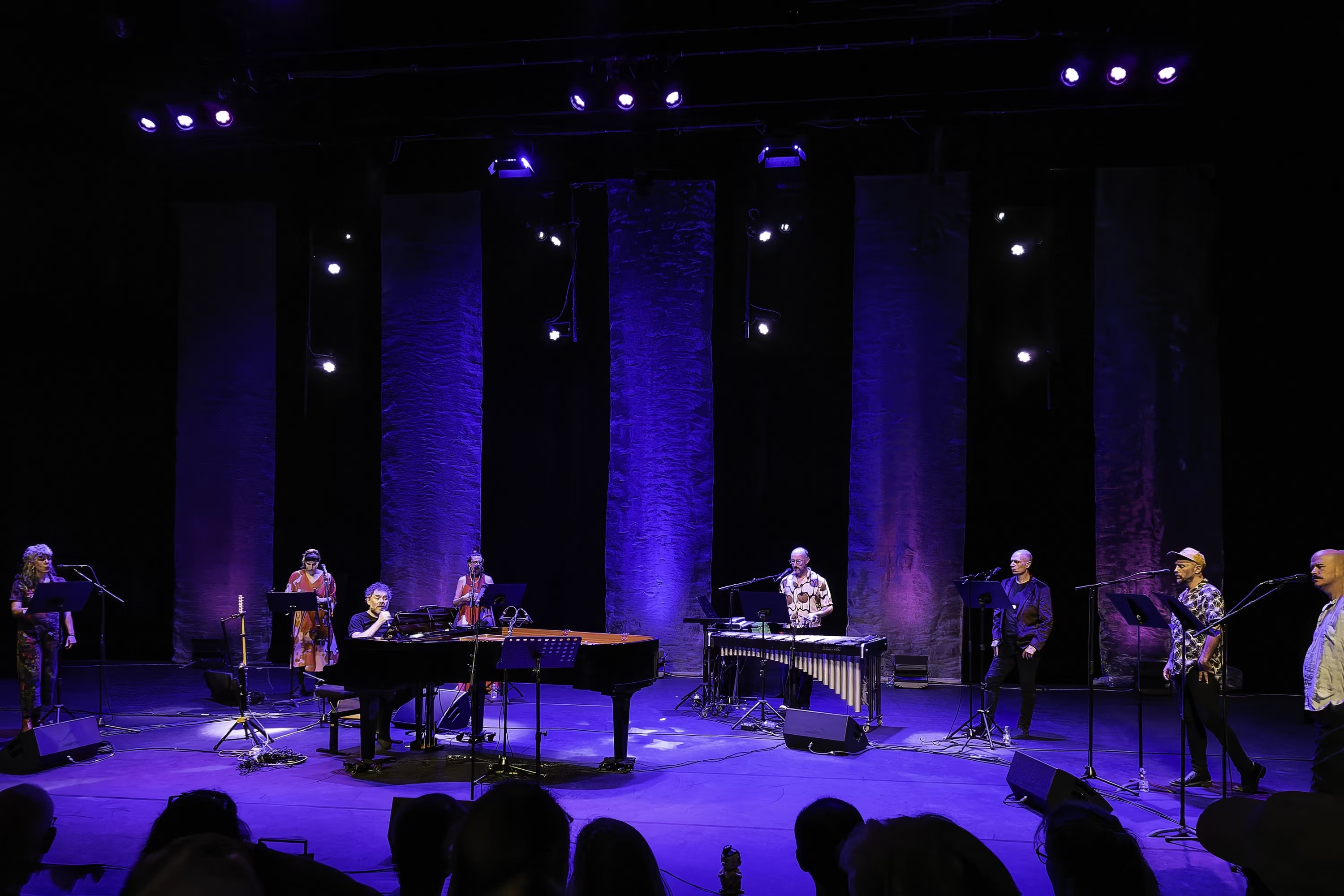
Caroline Shaw, a Pulitzer Prize winner in music, is a true star of the contemporary music scene. Equally at home in pop and contemporary classical music, the American composer moves fluidly and joyfully between genres. Her sumptuous *Partita* (2012) features eight *a cappella* voices, brought to life in remarkably surprising ways through the use of vocal techniques drawn from traditions around the world. The equally virtuosic Gabriel Kahane—a gifted folk singer and composer—pays tribute in his *Elevator Songs* to the extraordinary soloists of the ensemble Roomful of Teeth. It is a splendid program, offering a chance to discover two leading figures in new American music.
The review by L'Invitu :
The 9:30 p.m. concert featuring the American octet **Roomful of Teeth & Gabriel Kahane** opened with two songs by A Filetta: a new composition and *E Lode di u sepolcru*. Both were marvelous.
For once, tonight’s concert elicited mixed reactions from the audience—some were enthusiastic, while others were more reserved.
It must be said that Caroline Shaw’s music is highly unconventional.
The three movements (a fourth was performed as an encore) of her *Partita for 8 Voices* combine Western classical singing with vocal techniques from across the globe.
The piece incorporates elements such as Inuit throat singing, yodeling, Tuvan overtone singing, as well as spoken passages, whispers, sighs, and the recitation of texts...
The four movements are:
1. Allemande: Built around spoken instructions for drawing, interwoven with complex vocal chords.
2. Sarabande: A movement centered on dense harmonies and breathing techniques.
3. Courante: A textured piece employing a variety of vocal techniques (whispers, glissandos).
4. Passacaglia: A structure of repetitive variations that intensifies, culminating in throat-singing techniques.
The octet displays rhythmic virtuosity and an irresistible choral energy, yet it falls short of the emotion previously experienced
with José Sanchez and Alberto Garcia.
Gabriel Kahane’s *Elevator Songs* are more traditional in nature, involving an appropriation of the conventions of pop music.
The title and theme—an elevator in an imaginary, multidimensional hotel—immediately evoke Carla Bley’s *Escalator over the Hill*, as well as Michael Mantler’s compositions set to texts by Beckett.
With each change of floor, signaled by the vibraphone—acting as the elevator itself—the various singers (portraying hotel guests) are called upon to perform in registers unusual for them. Accompanied by a viola, vibraphone, piano, or bass guitar, they embody a gallery of guests—some deeply troubled, others simply overwhelmed by the complexity of their own existence.
Those who do not speak English might have appreciated a simultaneous translation to better grasp what is unfolding within this hotel.
À l'iniziu c'era a voce ? This evening, we have heard a full spectrum of what the human voice can produce.


Thursday, September 17

PPresentation
PUBLIC LISTENING SESSION: SOUND ARCHIVES FROM THE MUSEUM OF CORSICA’S PHONOTHEQUE
As part of the Polyphonic Singing Encounters (*Rencontres de Chants Polyphoniques*), an exceptional public listening session is being presented by Damien Delgrossi, in collaboration with the Museum of Corsica’s phonotheque (sound archive).
A unique immersion into the island’s musical memory—a journey through tradition, emotion, and the passing down of heritage.
The review by L'Invitu :
At 11:00 a.m., there will be a public listening session hosted by Damien Delgrossi and Dominique Bianconi, in collaboration with the sound archive of the Museum of Corsica.
Through recordings collected in the Balagne region (Calvi, Zilia, Speluncatu, Felicetu) since 1949, we explore the diversity of Corsican singing and its evolution up to the present day.
The speakers highlight the significance of Roccu Mambrini—a poet and singer from Zilia who wrote the lyrics to the Lamentu à Ghjesù, a piece now regarded as a traditional song.
We also discover that categories once thought to be definitive do not hold up against the evidence: monophonic songs used in chjami è rispondi (call-and-response exchanges), lamenti (laments) performed by men, and women singing the paghjella (which, incidentally, is not confined solely to the center of Corsica, among other examples).
What lies ahead for Corsican singing? We have reached a pivotal moment: as the last traditional singers pass away, future documentation will rely entirely on the recording industry.
The conclusion is a mix of optimism and pessimism—yet one must acknowledge the extraordinary richness of Corsican musical output, a phenomenon unique in Europe.


Presentation
HUMANOPHONES
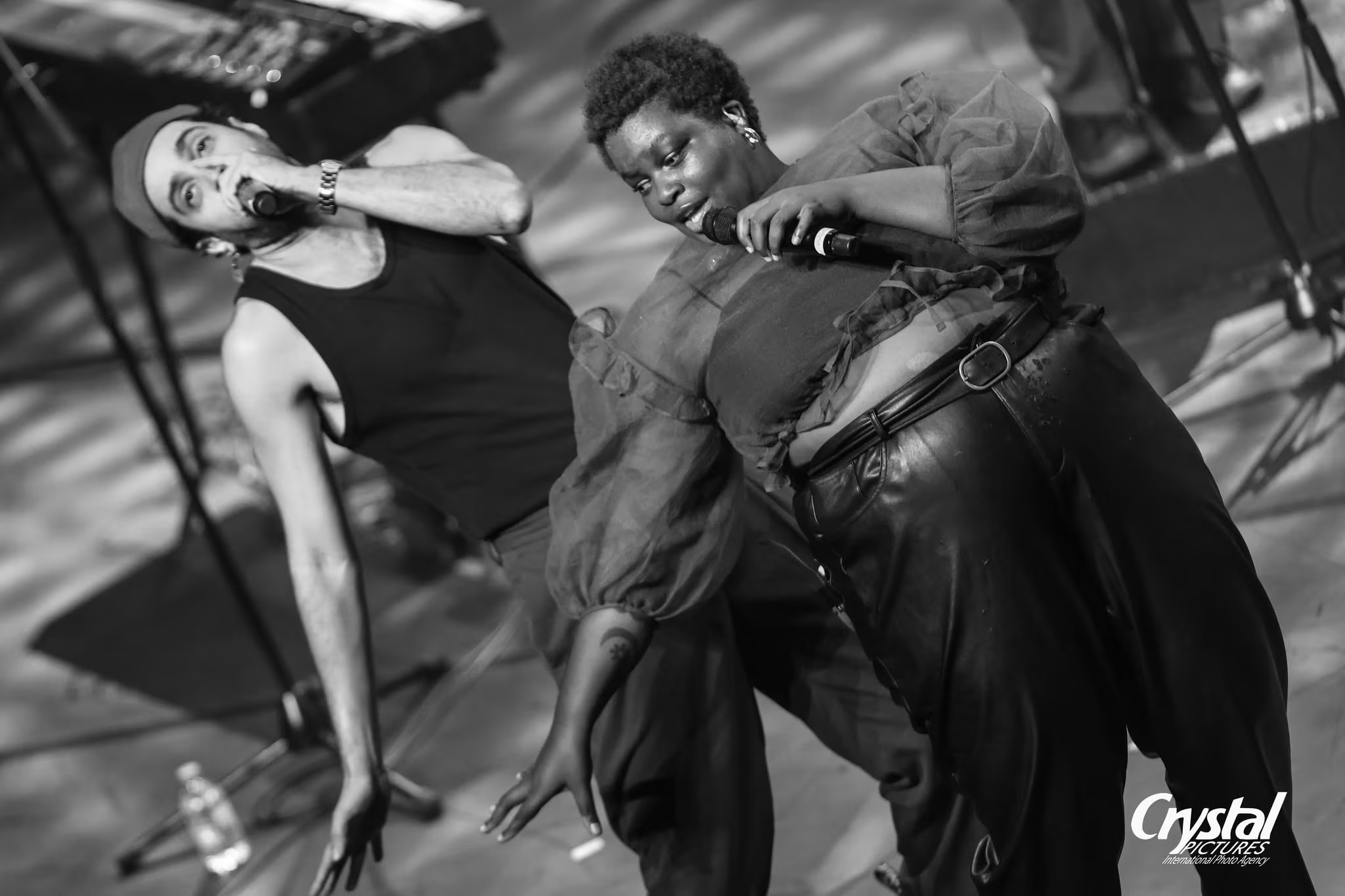
With *Antropus*, Humanophones invents an organic, innovative form of pop music produced entirely by the human body. Seven performers blend body percussion, vocals, and movement to create a sound infused with funk, neo-soul, and tribal influences—at once powerful and exhilarating.
Tongue clicks, foot stomps, friction, voices, breaths, and onomatopoeia weave together a sonic and visual universe that knows no borders. Somewhere between an urban trance and a contemporary ritual, the body re-emerges as the primary instrument, while voices transform into a universal, instinctive language that transcends mere words.
Yet, beneath the energy and virtuosity, *Antropus* interrogates our current era and our relationship with the world. Through a series of burlesque, poetic, and offbeat vignettes, the show explores themes such as digital scrolling and the pursuit of instant gratification, global warming, the loss of biodiversity, and the troubling excesses of our societal model.
Set against the backdrop of the Anthropocene, seven hominids lead us on a sonic and visual odyssey that examines our own contradictions: how can we become aware of our impact while continuing to move forward? What values should we choose to ensure we don’t lose our way?
Without ever resorting to moralizing, *Antropus* invites us toward awakening, collective vigilance, and the search for solutions—all while celebrating humanity’s most precious gift: the capacity to imagine, create, and transform.
The review by L'Invitu :
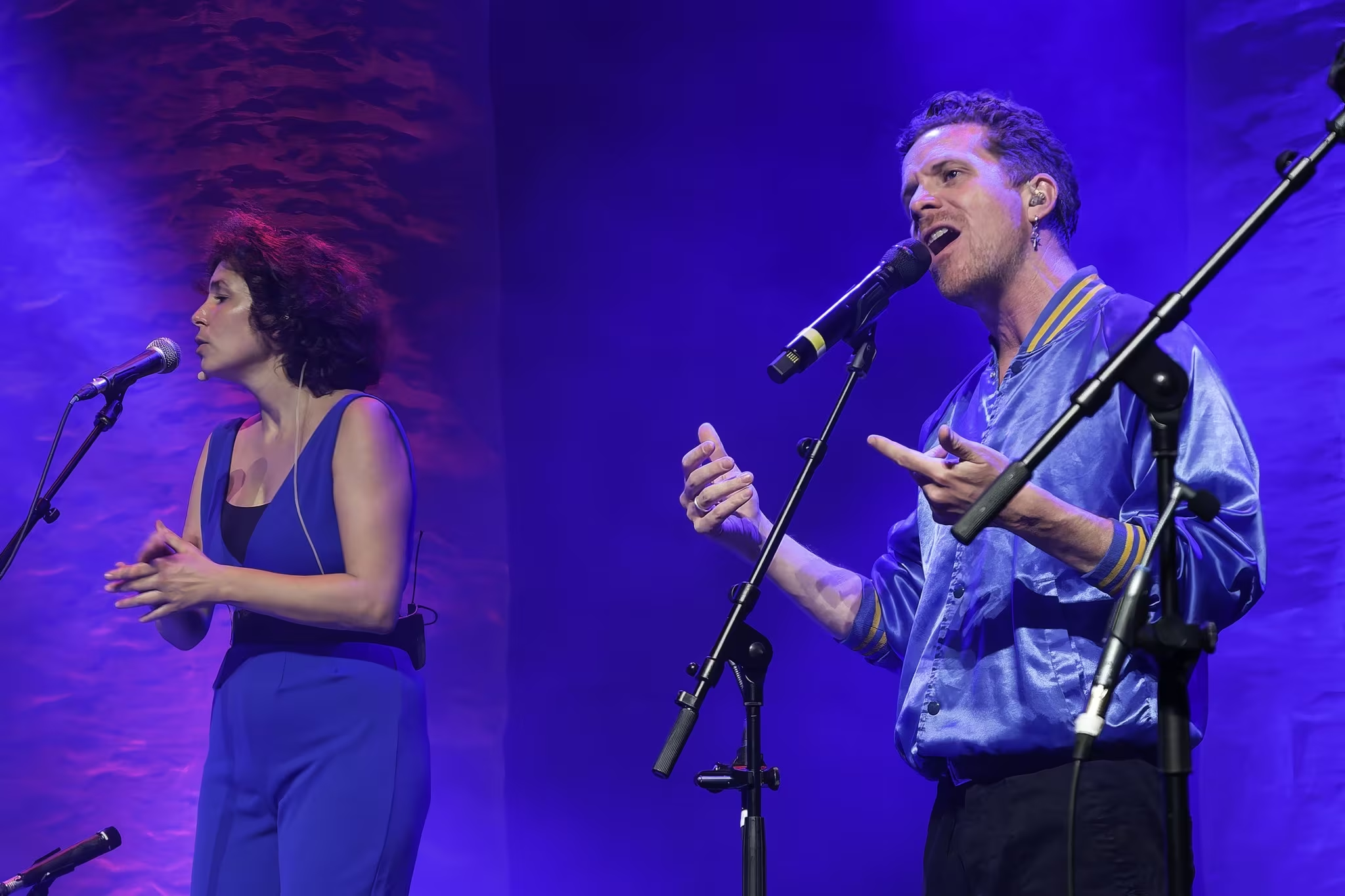
At 6 p.m., the ensemble Humanophones takes the stage. The music of this seven-member group is
produced entirely using the human body—through clapping, stomping, beatboxing, and singing.
Infused with soul and funk, their music evokes poetic imagery, accompanied by lyrics that address ecological issues and the madness of a lifestyle that destroys the natural world.
Featuring two exceptional singers and an exuberant stage presence, it’s a stimulating concert!
Although the performance began behind schedule, the Humanophones—with the audience’s enthusiastic agreement—decided to extend the show with an extensive encore.






Presentation
MALIHEH MORADI, KIYA TABASSIAN & HAMIN HONARI
In this new creation by Constantinople, an exceptional dialogue between Kiya Tabassian and singer Maliheh Moradi draws us into the heart of Iran’s rich civilization. A prominent figure among the new generation of artists, Maliheh Moradi left Iran several years ago to pursue her artistic path in freedom. Inheritor of one of the world’s most refined vocal traditions, she possesses a voice of great beauty, profound intensity, and remarkable mastery. Today, she stands out as one of the most promising female voices on the Iranian scene.
“The Voice of the Dawn” reveals the richness, poetry, and sophistication of a musical art form shaped over centuries, juxtaposing the treasures of Persian music with the original works of Kiya Tabassian. More than just a concert, this encounter celebrates creative freedom, the act of passing on tradition, and resilience. It highlights the essential role of the female voice in contemporary Iranian culture and underscores the power of art when it serves as a space for expression, memory, and hope.
A musical journey of great intensity, brought to life by one of the most beautiful voices from today’s Iran.
This project is supported by the Canada Council for the Arts and the Conseil des arts et des lettres du Québec.
The review by L'Invitu :
In the evening, after the groove of the previous concert, a return to calm with the two pieces from A Filetta, In ogni addiu and Stabat Mater, wonderfully gentle. A moment of ecstasy...


Kiya Tabassian—who has appeared at the *Rencontres* several times in various collaborations (with Ablaye Cissoko, Marco Beasley, Ghalia Benali, and, of course, A Filetta)—is joined tonight by percussionist Hamin Honari to accompany the renowned Iranian singer Maliheh Moradi.
By way of introduction, Kiya notes that since 1979, Iranian women have been completely excluded from the stage.
Tonight’s concert—a preview performance—unfolds as a long, continuous suite of Persian songs, in which Maliheh Moradi showcases the full breadth of her vocal range.
We are transported, spellbound.
This Thursday evening, many of us feel truly fortunate to be experiencing these *Rencontres*.
And, as an added delight, we were able to purchase an advance copy of the CD *Clair-Obscur*, a collaboration between A Filetta and Constantinople.
Unfortunately, with no CD player on hand, we will have to wait a little longer to discover it (and write a review).


Friday, September 18

Presentation
"Salon de musique" by Franck Tenaille : Music of the Silk Roads
MUSIC SALON – FRANK TENAILLE
Throughout a remarkable history, the so-called Silk Roads—connections between East and West—have given rise to countless fantasies and myths.
They were traversed by merchants, diplomats, pilgrims, and travelers, as well as by musicians.
Along this intricate web of routes—punctuated by caravanserais and legendary crossroads cities such as Chang’an/Xi’an, Samarkand, Bukhara, Kashgar, and Constantinople/Byzantium—musical repertoires, modes, and rhythms were exchanged between the Arab, Turkish, Persian, Indian, and Chinese worlds. Frank Tenaille will explore these age-old exchanges, illustrated with musical excerpts.
Frank Tenaille
Hailing from the home region of Boby Lapointe, Tenaille has been a journalist since the 1970s—covering international geopolitics before shifting his focus to world cultures and music
(for publications including *Droit de Réponse*, *Libération*, *Le Nouvel Observateur*, *Le Monde de la Musique*, and *La Quinzaine Littéraire*). He has served as editor-in-chief for several periodicals, including the pan-Southern cultural monthly *César*.
He is the author of numerous books, including: *Les 56 Afriques* (Editions Maspero); *Guy Bedos, Histoire d’un rire* (Seghers); *Le Roman de Coluche* (Laffont); and *Le Printemps de Bourges, histoire des musiques d’aujourd’hui* (Gallimard). *Sans Visa: A Guide to Music from the Francophone World and Beyond* (Editions Zone Franche); *Le libre parcours d’Eve Griliquez* (Editions du Layeur); *Chant et polyphonies corses* (Editions du Layeur); *Le Swing du caméléon: A Panorama of African Music* (Actes Sud); *Le Raï: Between Hybridity and Recognition* (Actes Sud / Cité de la musique); *Musafrica: Portraits of African Music* (Editions du Layeur); *Musiques sans visa: 20 Years of the Saint-Nazaire Festival*; *Musiques et chants en Occitanie* (Editions du Layeur); *Coluche, même pas mort* (Calmann-Lévy); *Le Cabaret sauvage: Twenty Years of a Venue Open to the World* (Editions du Layeur).
A founding member and former president of Zone Franche (a network for world music), he has served as an artistic programmer for various festivals, including Equinoxes, Nuits blanches pour la musique noire, Le Printemps des Comédiens, and Radio-France Montpellier.
He is the artistic director of Le Chantier (a center for world music creation) and a member of the Académie Charles Cros.
The review by L'Invitu :
A look back at the wonderful tribute paid to Philippe-Jean Catinchi in issue no. 3 of La Gazette, featuring a beautiful piece by Franck Tenaille.
As an aside, we had a good laugh discovering the jokes made by the cartoonists about his legendary cropped trousers—which we had nicknamed "philippejeans" among ourselves.
At 11 a.m., Franck Tenaille took us along the Silk Roads.
It was a fascinating presentation, revealing how various cultures have interacted over the centuries. From Chang'an in China to Constantinople—passing through Persia, Kazakhstan, Samarkand, and Kashmir—ideas, religions, arts, and music traveled alongside the merchants. Captivating, as always.


Presentation
SÉAMUS & CAOIMHE
Hailing from a lineage of musicians deeply rooted in Connemara, Séamus and Caoimhe Uí Fhlatharta embody a new generation of artists committed to the richness of the Irish tradition.
Originally from An Áird Mhóir, in the heart of the Gaeltacht region of County Galway, they are particularly noted for their mastery of *sean-nós*—a traditional Gaelic vocal art performed *a cappella*—as well as for their unique arrangements of songs in both Irish and English.
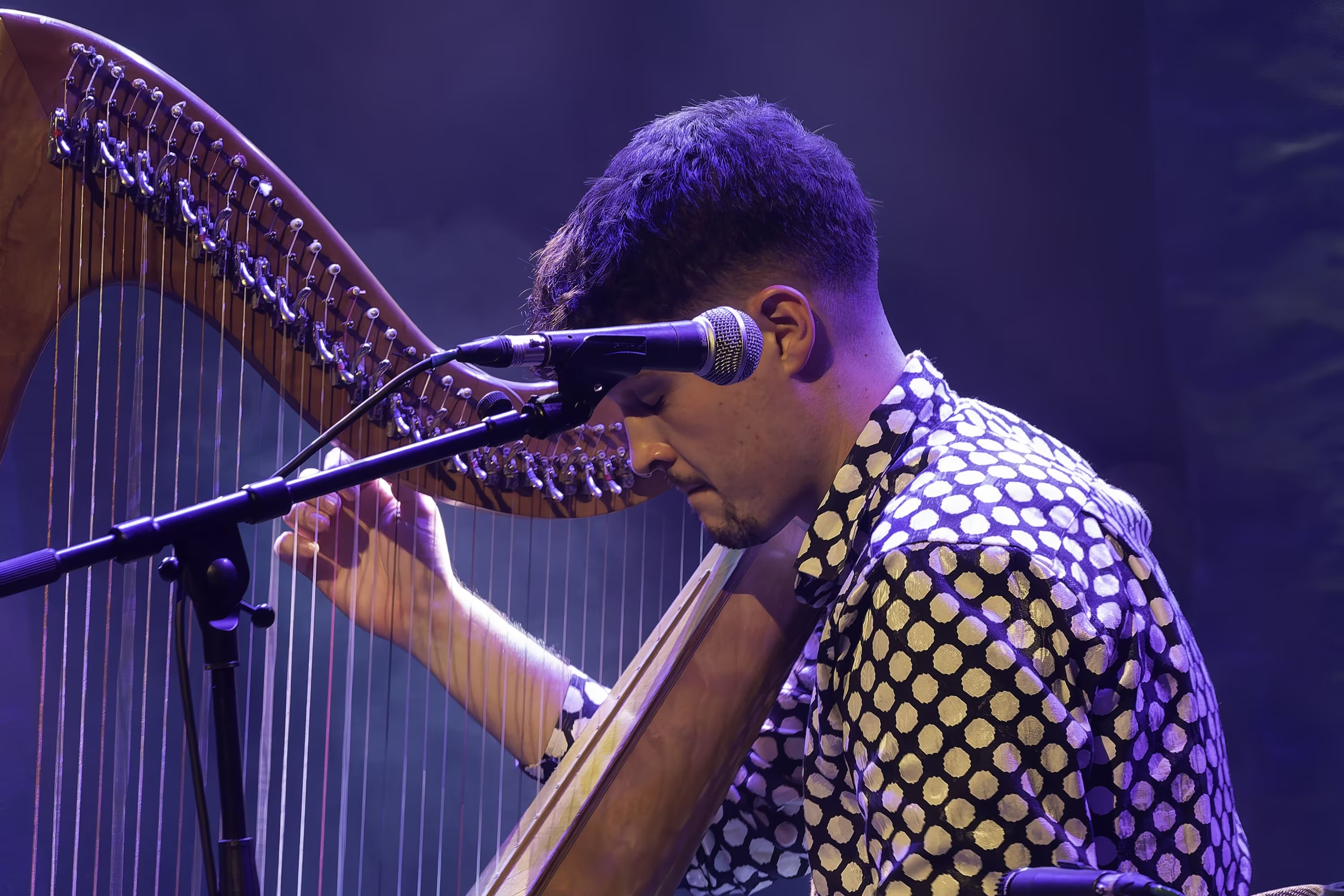
Séamus—on vocals, harp, and *bodhrán*—and Caoimhe—on vocals and fiddle—engage their voices in a dialogue marked by a truly singular, sibling-like rapport.
As multi-instrumentalists and Irish dancers—both of whom have won awards at the All-Ireland Championships—they bring their cultural heritage to life with infectious energy, placing the Irish language and music at the core of their artistic practice. Their world, at once intimate and vibrant, creates a natural dialogue between cultural memory and contemporary creation.
Released in 2023, their self-titled album is the result of a collaboration with Brian Whelan and Bill Whelan, the composer best known for *Riverdance*.
Recorded at The Fort studio in Roundstone, Connemara, the album reveals a sound that... At once authentic and contemporary, where the power of traditional melodies blends with subtle, personal arrangements.
Séamus Uí Fhlatharta – Vocals, bodhrán, harp
Caoimhe Uí Fhlatharta – Vocals, fiddle
The review by L'Invitu :
The 6 p.m. set featured Irish performers Séamus and Caoimhe Uí Fhlatharta—a brother and sister renowned for their sean-nós singing (a traditional, unaccompanied Irish vocal style) and their unique arrangements of Irish and English songs.
Séamus plays the harp and flute and also dances, while his sister plays the fiddle, organ, and flute. Some pieces are performed a cappella, while others are accompanied by rhythmic foot-tapping.
Their voices blend with great subtlety across melodies that range from the gentle to the highly danceable, including a virtuosic interlude played on small Irish flutes. A beautiful concert.




Presentation
A FILETTA : L'ante nove
The music of A Filetta is a journey... One might describe it as a contemporary polyphonic vocal offering, rooted in a powerful oral tradition.
It began in 1978, when a group of very young people—driven by a fierce determination to help safeguard an oral heritage that was in sharp decline—set out on a path. It has been a long road, at times winding, yet marked by remarkable discoveries and extraordinary encounters.
The singers themselves readily admit that the concept of the "encounter" is woven into their musical DNA. This explains why they chose not to confine their journey to the boundaries of their own roots: while anchored in the tradition they inherited, they quickly opened themselves to other horizons—new territories, different disciplines, and a wide array of artists, including performers, composers, directors, and choreographers.
The repertoire they present today is a true reflection of their evolution since the early 1980s: a trajectory that began within an age-old oral tradition and has since unfolded through a creative approach—one that is uninhibited, liberated from the constraints of strict traditional adherence, and free to explore new paths. Side by side, one finds sacred and secular songs with diverse influences, film scores by Bruno Coulais, compositions for choreography by Sidi Larbi Cherkaoui, choral excerpts based on Greek or Latin mythology, and pieces from a requiem commissioned by the Saint-Denis Festival.
This music serves a worldview that unequivocally rejects any form of insular identity-based withdrawal—a philosophy that might be summed up by this beautiful aphorism from René Char: "The purest harvests are sown in a soil that does not exist; they dispense with gratitude and owe their existence only to the spring."
Voix - Jean-Claude Acquaviva, François Aragni, Jean-Do Bianco, Petr’Antò Casta, Paul Giansily, Jean-Vincent Servetto, Maxime Vuillamier
The review by L'Invitu :
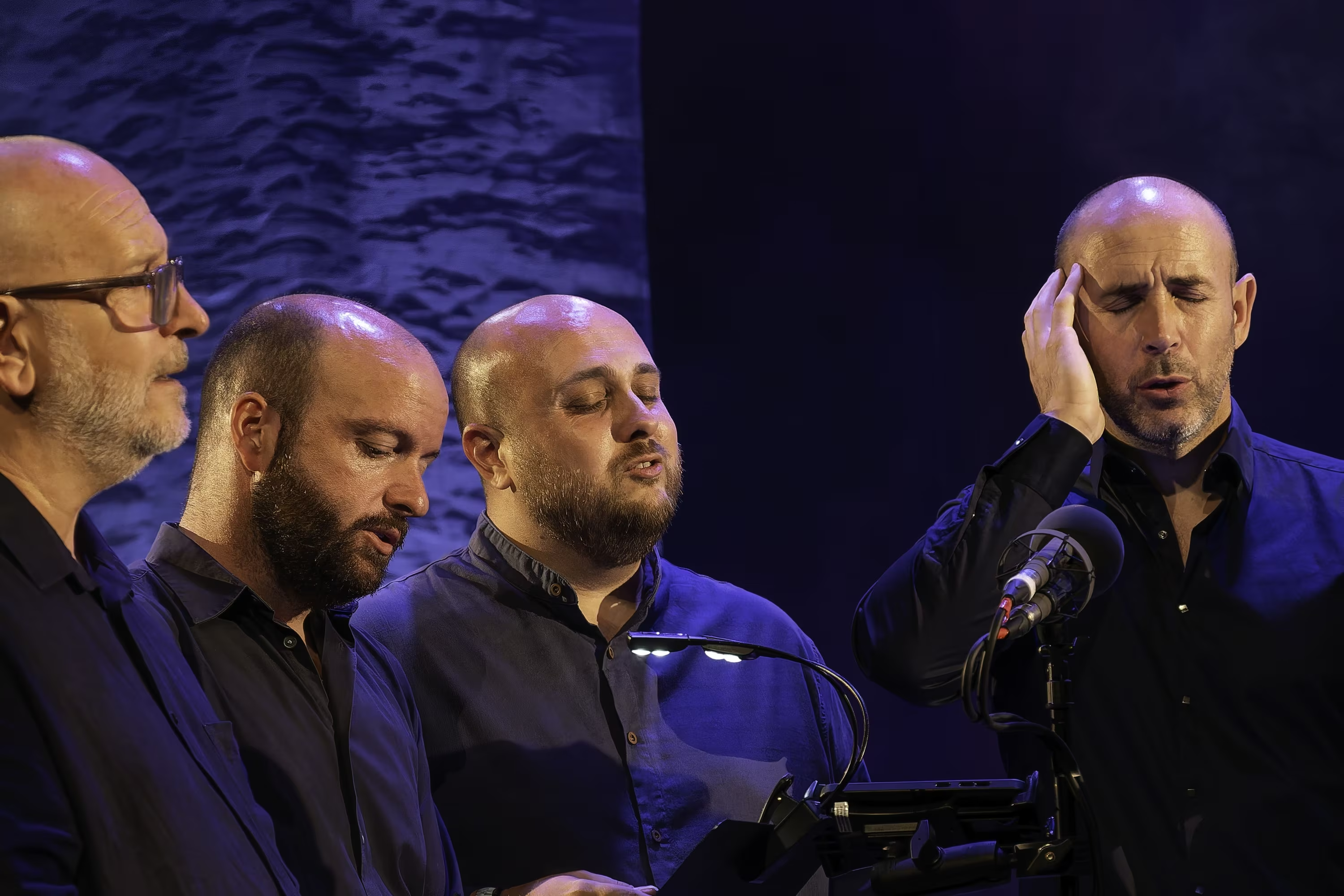
This Friday will be remembered as an evening marked by deep emotion. To begin, François Canava and Jean-Claude Acquaviva paid a moving tribute to Philippe-Jean Catinchi, as well as to Stéphane Casalta—who passed away just over a year ago—and to Chloë Aldrovandi, an 18-year-old student who was shot and killed in February 2025 in Ponte-Leccia.
The emotion continued as Jean-Claude made a passionate appeal for peace and harmony, rooted in justice.
Then came the musical emotion.
Having followed A Filetta for over thirty years, one might expect to become jaded—but the exact opposite is true: at every concert, we remain in awe of such technical mastery, all in the service of profound emotion.
Tonight’s performance was enchanting from start to finish, culminating in a deeply affecting Lamentu à Ghjesù that brought tears to the eyes of many in the audience.
Prior to that, the seven singers delighted us with (though not necessarily in this order): Kyrie, Lacrimosa, Sub Tuum, Requiem, two songs based on texts by Pessoa—Ruvine sò and E chjarine de l'angoscia—as well as Benedictus, Bon ghjornu Madamicella, and Si more a cità. (Oedipus Rex), two excerpts from Don Juan, "Happy Birthday" (from The Libertine), Norbu, "Karma’s Anger" (from Himalaya: The Childhood of a Chief), and "The Cardinal’s Madness."
One leaves the concert in a trance-like state, one’s heart full of love.




Saturday, September 19

Presentation
ROSELA LIBERTAD
Rosela Libertad, a singer and guitarist originally from Argentina and now based in Corsica, draws her inspiration from the music of the Argentine plains—milongas, estilos, zambas, waltzes, and tangos—which form the core of her repertoire. Accompanied only by her guitar and her voice, she offers a musical journey into the heart of Latin America.
In Alegoría Argentina, Rosela traverses the vast musical landscapes of her homeland, shaped by the intersection of folk traditions, cultural heritage, and the history of immigration. She presents timeless songs that weave together the memory of Argentina with an openness toward musical cultures from across the globe. Her voice—at once deep, luminous, and expressive—forges an intimate, direct connection with the audience.
Since settling in France in 2021, she has engaged in numerous collaborations, most notably with Stéphane Casalta, with whom she has worked on several projects: the duo Magicanima, Canti a Lucendiluna (with the Armoniosoincanto choir from Perugia), the album Animantiga, and Dì u mare—a performance blending Mediterranean songs and poetry.
Her career has led her to perform at events such as the World Music Festival in Sassari, the Rencontres Polyphoniques de Calvi, Festivoce, and Les Suds.
Arles, as well as sharing the stage with pianist and composer Oscar Del Barba. Through her performances, Rosela Libertad creates a dialogue between Argentine and Mediterranean cultures, within a musical universe that is at once authentic, generous, and profoundly human.
The review by L'Invitu :
<As is the case every year, the Saturday morning concert was held in the Church of Saint Mary in Calvi.
Once again, it was a performance filled with deep emotion.
From the very first piece, we were captivated by the purity and precision of Rosela Libertad’s voice—notably in a composition by Carlos Gardel.
The second part of the concert was dedicated to three individuals who played a significant role in Rosela’s life: the first piece was dedicated to her father;
the second to René Favaloro, the renowned Argentine surgeon who developed the coronary artery bypass graft technique (which he famously refused to patent, ensuring it would remain freely available to all).
On July 29, 2000, he took his own life, driven to despair by the corruption and economic collapse in his country, which had put his foundation at risk.
The third piece—the most moving of all—was dedicated to Stéphane Casalta, and the concert concluded with Gounod’s Ave Maria, sung a cappella.
We left this beautiful concert deeply, profoundly moved.


Presentation
MICROLOGUS - Dir. : PATRIZIA BOVI
Saint Francis of Assisi celebrates all creatures and all elements—earth, water, air, and fire—in his famous *Canticle of the Creatures*, composed in 1225. Considered the first major text in the Italian vernacular to have survived in its entirety, the *Canticle of Brother Sun* was intended to be sung. A 13th-century manuscript, held in the library of the Sacro Convento in Assisi, contains the opening verses and shows space left for a melodic line—one that was never actually notated. This program presents, for the first time, a musical reconstruction of the *Canticle of the Creatures*, based on a fresh reading of its oldest sources and the liturgical tradition that Saint Francis and his friars were accustomed to singing. In his *Legenda maior*, Saint Bonaventure recounts that Saint Francis would invite all creatures to praise God "in the manner of the prophet David"—that is, in a psalmodic form.
The journey continues with Hildegard of Bingen (1098–1179)—a German mystic, abbess, and composer—whose work reveals a remarkable understanding of the natural world. In her writings devoted to created beings, she explores the plant, animal, and mineral realms, within a universe conceived as a balance among the four elements. Her visions, her philosophical thought, and her musical compositions—which rank among the masterpieces of medieval music—reveal a profoundly spiritual and sensitive conception of the living world.
At the end of the 15th century, the theologian Raymond of Sabunde also dedicated his Liber Creaturarum—the Book of Creatures—to nature as the primary revelation of the divine. For him, the "book of nature"—a work of God that cannot be falsified—enables human beings to better understand the world, to know themselves, and to approach a knowledge of God.
Through these three major figures of medieval thought, Francesco, La natura e il divino explores the bond that connects human beings to nature and to the living world as a whole. This reflection finds a contemporary echo in Pope Francis’s encyclical Laudato si’, which calls for us to care for our "common home" and to rethink our relationship with the world around us.
MicrologusPatrizia Bovi - Voice, harp, natural trumpet
Federica Bocchini - Vocals, cymbals
Enea Sorini - Voice, cittern, percussion
Goffredo Degli Esposti - Bagpipes, flute and drum, double flute
Gabriele Russo - Hurdy-gurdy, rebec, lyra, natural trumpet
Matteo Nardella - Shawm, bagpipes
The review by L'Invitu :
We had expected a somewhat austere concert, but that was far from the case; the music presented by Patrizia Bovi and her ensemble, Micrologus—a musical reconstruction based on the liturgies from the time of Saint Francis of Assisi—was remarkably cheerful and beautiful, featuring, among other pieces, a joyful song from the Laudario di Cortona (13th century) titled Sia laudeato San Francesco. With three fine voices—Patrizia, Federica Bocchini, and Enea Sorini—along with excellent musicians and a striking array of instruments (bagpipes, shawm, hurdy-gurdy, rebec, flutes, and two remarkable natural trumpets), the ensemble delivered an outstanding concert centered on a highly relevant theme: the connection between human beings and the natural world. Could the "Poverello" of Assisi be history’s first environmentalist?


The review by L'Invitu :
9:30 p.m. : The Calusgiule (sparks) twinkle one last time before going out. From the top of the stands, A Filetta sings Letterella before joining the stage.
Will follow one another Nicola Segatta, Maliheh Moradi and Hamin Honari, Seamus & Caoimhe from a loggia, Micrologus and finally
A Filetta for two pieces,
the Song of the suitors fromUlysses ("L'acqua hè paziente, noi nó)" and La folie du cardinal from "Le Libertin".


We always feel a slight sense of frustration after the finale, as we would love to see more of the guest performers from the *Rencontres* (encounters/collaborations), while also getting to enjoy a full concert from the featured artist. Likewise, is it better to have the guests perform first, or the main artist? There is no clear-cut answer. As I recall, the finale used to end at a later hour—I specifically remember Còr de la Plana getting the entire *Place d’Armes* up and dancing. But then again, memory can be deceptive.

And it’s over... We leave the lobby of the performance venue—which, throughout the week, became a wonderful space for connection and friendship—with a sense of regret.
It’s a bittersweet feeling—a mix of happiness and sadness. But we will surely meet again in a year’s time, s’è Diu vole [God willing]...
The concert hall:

The cartoonists
<Fourteenth year featuring our lively team of editorial cartoonists!
The Gazette
Under Serena’s guidance, the "Gazette du Polyphone" has become an institution.
Available daily at the shop and distributed in the venue’s lobby, it features the best sketches from our illustrators,
text by François Canava, and a short piece ("La Rubrique") by the author of these lines (a brief, "hot-off-the-press" summary of the daily events, which you
can read above).
Each of the five issues of the Gazette can be downloaded as a PDF from the Rencontres website: https://www.rencontrespolyphoniques.com/gazette
The Text by Franck Tenaille:
The 38th edition of the Polyphonies de Calvi festival has just concluded successfully.
Spearheaded by the group A Filetta and the highly active association U Svegliu Calvese, the event showcased a vibrant spectrum of offerings from Korea, Brittany, the United States, Iran, Italy, Ireland, Argentina, and Corsica—ranging from baroque music blended with flamenco, alternative and physical pop, and medieval music, to *sean-nós* singing, the *radif* tradition, and *paghiella*, among others. The only somber note was the absence of a key figure in these gatherings: the historian and journalist Philippe-Jean Catinchi, who passed away in July.
PHILIPPE-JEAN CATINCHI: A POLYPHONIC VOICE
A cartoon by Batti captured him perfectly, depicting him as a voluble figure, powered from behind by those famous Duracell batteries. That was Philippe-Jean: a torrent of words, an insatiable curiosity, and a vibrant, restless energy.
He might have been exhausting, had he not also been utterly fascinating, singular—and, in a word, brilliantly original. His personality was a concentrated beam of erudition, one he was always eager to share, encouraging others to explore,
to think critically, and to refine their tastes. A historian by training—with intellectual roots tracing back to Philippe Ariès and Robert Mandrou, the pioneers of the "history of mentalities"—he was also an educator and, from 1994, a literary critic for *Le Monde*. He dedicated his talents to stripping away the rigid constraints surrounding ideas and systems of thought, and to fostering a living, breathing memory—one that was anything but a museum piece.
For my part, I first encountered Philippe-Jean through an Occitan writer we both knew: Max Rouquette (1908–2005), whose name was once put forward for the Nobel Prize in Literature. Philippe-Jean—frustrated by the fact that he couldn’t study his family’s native Corsican language at his high school in Lyon—had become interested in... ...Occitania, through courses in the Occitan language. And so it is that, within his own literary Olympus, the author of that pantheistic work *Vert Paradis* finds himself in the company of Marguerite Yourcenar, Vladimir Nabokov, and Italo Calvino—a quartet that mapped the contours of his psyche. These four master craftsmen of visceral prose shared a deep engagement with myth, the experience of exile (whether geographical, political, or linguistic), and the nature of memory—not to mention a profound ecological sensibility.
Those who knew him experienced this man—gifted with an extraordinary, all-encompassing memory—as a perpetually youthful spirit; this was evident in his sudden flashes of insight, his boundless enthusiasm, his deeply scholarly passion for children’s and young adult literature, and the role he played as a mentor—or even a godfather—to emerging authors.
Fanfan la Tulipe—a spirited, somewhat elusive figure whose skill in fencing echoed his academic background in medieval studies—hailed from a family of musicians from Cap Corse. He harbored a profound passion for Corsica and its culture (as evidenced by his 1999 essay, *Polyphonies corses*), and, by extension, for marginalized languages and cultures. This passion fueled his multifaceted involvement in island life: from the *Una Volta* comics festival and the *Libri Mondi* literary gatherings to the *Leghje a Corsica* publishers’ fair, and, perhaps most dear to him, the *Rencontres* (gatherings) dedicated to polyphonic singing. In these settings, he was, in a sense, a polyphonic voice all on his own—much like his beloved Kurosawa, who, as he often pointed out, would juxtapose the conflicting accounts of different characters regarding a single event to weave complex, choral narratives. In this regard, his most precious legacy to the Calvi-based gatherings—as Jean-Claude Acquaviva aptly noted—was his commitment to "helping combat ignorance, the root of all dangerous excesses." And, in these unforgiving times, that was no mere luxury.
FRANK TENAILLE
The tops
It’s difficult this year to single out any one concert, as they were all of such high quality.
Ultimately, it comes down to personal taste. For my part—setting aside the performances by A Filetta, which are in a league of their own—it was Rosela Libertad, José Sanchez, and Alberto Garcia,
as well as Kiya Tabassian and Maliheh Moradi, who resonated with me the most.
But the real highlight of the *Rencontres* each year is the extraordinary kindness of all the volunteers (I should perhaps say "all the women volunteers," as they are predominantly female!)
The flops
The only letdown of this edition was the absence of the attractive brochure that presented the shows.
Calendrier perpétuel des Rencontres
(merci à Max pour ses explications)
1996 : 10 au
14 septembre
1997 : 16 au
20 septembre
1998 : 14 au
18 septembre
1999 : 14 au
18 septembre
2000 : 12 au
16 septembre
2001 : 11 au
15 septembre
2002 : 10 au
14 septembre
2003 : 16 au
20 septembre
2004 : 14 au
18 septembre
2005 : 13 au
17 septembre
2006 : 12 au 16 septembre
2007 : 11 au 15 septembre
2008 : 09 au 13 septembre
2009 : 15 au 19 septembre
2010 : 14 au 18 septembre
2011 : 13 au 17 septembre
2012 : 11 au 15 septembre
2013 : 10 au 14 septembre
2014 : 11 au 15 septembre
2015 : 15 au 19 septembre
2016 : 13 au 17 septembre
2017 : 12 au 16 septembre
2018 : 11 au 15 septembre
2019 : 10 au 14 septembre
2020 : 15 au 19 septembre
2021 : 14 au 18 septembre
2022 : 13 au 17 septembre
2023 : 12 au 16 septembre
2024 : 10 au 14 septembre
2025 : 16 au 20 septembre
2026 : 15 au 19 septembre
2027 : 14 au 18 septembre
2028 : 12 au 16 septembre
2029 : 11 au 15 septembre
2030 : 10 au 14 septembre