
A FILETTA :
Chronological milestones
You are here : Music / Corsican singing / A Filetta / Chronological milestones
48 years!! An exemplary journey—strewn with obstacles, but also marked by significant encounters. Here, we will retrace the various stages of this path.

A Filetta : a unique journey
At the end of 1978, an evening brought together Michele Frassati, Dedé Nobili and Tumasgiu Nami. They decide to form a group, called A Filetta by Dédé Nobili. Jean-Marc Acquaviva suggested to the emerging group that he join his younger brother, Jean-Claude, then aged 13! And the Mariotti brothers and Jean Sicurani join the group.
Within the first four albums
:Machja n’avemu un altra (1981), O
vita(1982)
Cun tè (1984) and In l’Abbriu di e stagione (1987), the style of A Filetta is
draws little à little with specific rhythms and texts of a
great poetry (Mare, Cun tè, O Vita).
At the same time, while remaining highly active in the cultural sphere, the group
conducted research into traditional polyphony—both in the Balagne region
and beyond. This endeavor led to the 1989 release of A u
visu di tanti,
which features traditional sacred polyphonic pieces—such as O
Salutaris (u
Mucale) and the Requiem (from Rusiu)—as well as
secular works (like Paghjella di
Tagliu). These are presented alongside original musical compositions that
depart significantly from the past (such as Anima, in which the
group incorporates
traditional instruments like the cetera*, the pivana*, and various
percussion instruments). It
was with this album that the group reached a key turning point, introducing an
original
polyphonic composition (U Lamentu di Ghjesù)
that integrates
seamlessly—particularly in terms of its melodic trajectory—into the island’s
oral
tradition. This song, which evokes intense emotion, remains part of the group’s repertoire to this day, in 2026.
It was during this period—largely through contact with
religious brotherhoods—that the composition of polyphonic
sacred songs began to take shape.
* pivana : The Pivana is a wind instrument, belonging to the flute family, entirely carved from a goat horn.
* cetera : The cetera is the Corsican variant of the cistre, a plucked string musical instrument.
In 1989, A Filetta reached a new milestone by becoming involved in
organizing the "Rencontres de chants polyphoniques de Calvi" (polyphonic encounters) in Calvi. "It was a second turning point—a
realization that we should move toward openness while still preserving our
distinctive character. Moreover, it met a genuine need,
because in music, nothing is set in stone," explains Jean-Claude Acquaviva.
For fifteen years, the group broadened its horizons through
exchanges with other traditions, such as those of Greece,
Albania, Sardinia, and, above all, Georgia.
"There was an
immediate, powerful connection with the
Georgians. As soon as they began to sing, it felt
as though they were reflecting an image of us back to ourselves—it was quite
surprising.
We recognized in them the same gestures, the same ways of searching for one another
within the song. In fact, in terms of harmony, their music
is very close to
our own. Consequently, we began singing Georgian songs, and two years later,
they returned—singing our songs. They could easily have been
Corsican singers. (...) These encounters return our singing to its
source: in hearing people from the Caucasus, Albanians,
Kabyles, Turks,
or Syrians sing, we hear a part of ourselves. (...) We
have
spent entire nights singing with Mongols or Inuit people without
exchanging a single word."
In 1992, was released Ab Eternu, almost
entirely dedicated to liturgical songs (mass of
deceased, Holy Week) with the exception of Sumiglia,
dedicated to the memory of Ghjuvan Battista Acquaviva.
In 1994 the album « Una
Tarra ci hè ». This album is that of maturity, with creations as well
polyphonic (A Paghjella di l'Impiccati, U
Lamentu di Maria), that with
instruments. All these creations are of high quality.
At the same time, U
Svegliu Calvese having decided to resume the tradition of Holy Week in Balagne,
A
Filetta invested again in 1993 to take over this
manifestation, reconnecting with
the approach initiated ten years ago. “For us, it’s about giving
A
more human face à the Passion: the story of a man before that of
son of
God."
Released in 1997, Passione is an album
exclusively dedicated to to the songs of the Passion, let them be
traditional
or group compositions. The meticulous architecture of the voices, the
burning lyricism
and the gripping interpretation sweeps away any prejudice. not to
leave room thatà universality of art.
In this album, note
particularly U Sipolcru and A Sintenza, two
compositions by Jean-Claude, an iconic Georgian song, Ghmerto,
as well as a new version, more dramatic than the first, of U
Lamentu di Ghjesu.
In 1998, the
Neapolitan director
Orlando Forioso directs The Passion. This
reconstruction in lingua
corsa of the last days of Christ's life is played in
the citadel of
Calvi by thirty volunteer actors accompanied by A Filetta.
This
show is given again the following year, on April 3, 4, and 5, 1999. The
Passion
also inspired the Via Crucis, presented on March 30 and 31,
2002,
within the Citadel. This Stations of the Cross—punctuated by texts drawn
from modern literature (Borges, Primo Levi, Filippini)—was staged
by Orlando Forioso; it was restaged specifically for the television channel FR3
in early February 2003 and subsequently broadcasted
on television at Easter that same
year.
Médée
The group was to reach another
significant milestone: one evening
in August 1995, during a concert held at the Oratory of Saint Anthony in
Calvi,
the group met the young stage director Jean-Yves Lazennec.
The idea
of a collaboration was raised, and a few months later, a
project took shape to stage an ancient text: Seneca’s Medea.
The musical composition was entrusted to the group, which
translated the Latin text into Corsican. Then, on November 12, 13, and 14, 1997,
A Filetta
presented the choruses from Medea at the Bastia theater.
Jean-Yves Lazennec remarks: "A Filetta offers something
unprecedented,
entirely new, and virtually unclassifiable—something that bears no real
resemblance to anything else they have undertaken, either before or
since. It is a poignant tension between the near and the far,
serving a harrowing tale of a failed love affair and the rejection of
the outsider,
in which the artist’s creation sheds a surprising light upon the
present."

Bruno Coulais described this six-part composition as an "unidentified musical object."
While this work draws its inspiration from the island’s oral tradition, it also evokes other oral traditions from across the Mediterranean basin.
The group would go on to refine, polish, and expand upon this piece—performing excerpts of it during various concerts. Although some portions can be heard on the album "Intantu", the complete set of choral pieces for "Medea" was not released on CD until June 2006..

In 2007, "Medea ritratti di voci" was created, in collaboration with an actress and a singer from Sardinia (Lia Careddu and Elena Ledda) and musicians from the Livorno Conservatory.
Six performances were given in Porto Torres, Livorno, and Calvi.

Bruno Coulais
In the audience, the composer Bruno Coulais—best known for his film scores—was left spellbound and expressed a desire to meet the group, whom he had previously heard in Lama. In a film by Don Kent (broadcast on Arte and released on DVD), he remarked: "Nothing was written down. Jean-Claude likely had the whole thing in his head—which is quite dizzying, because while traditional music is passed down orally, to create a work by holding it entirely in one’s mind—without ever putting it on paper, and by singing each phrase to each musician, and pulling it off—it’s truly
impressive.”
This encounter first gave rise—as early as the following January—to the
soundtrack for Jacques Weber’s "Don Juan", composed by Bruno
Coulais with
lyrics by Marcellu Acquaviva, performed by the group, and featuring
several
tracks sung by mezzo-soprano Marie Kobayashi. This marked a
new turning point
for the group; their already growing reputation would
now cross borders, reaching an international scale.
"We
really struggled—it was a six-part score, and we had to work it out
note by note on the piano. We had twenty days
to perfect eight songs, but we also shared a lot of laughs, especially
during
rehearsal sessions at Tao’s place in Calvi,"
the group members recall
(in an interview with Bernadette Spagnoli for *Corse Hebdo*).
"Bruno
took some risks, but he placed his trust in us right from the start,"
adds
José. And three days before the recording, everything was ready.
Let’s hear from Bruno Coulais (on Traxzone, www.musiquedefilm.com):
"Meeting the group A Filetta was a revelation for me.
Not
just a musical revelation, but a human one: they possess an incredible
emotional
strength! Previously, I had worked extensively with operatic voices—
notably
with Marie Kobayashi on Microcosmos and other films. But
then
I discovered the experience of working with natural voices—voices that seem
to come
from very far away, yet are simultaneously so contemporary. The natural
voice
is something that never goes out of style; it conveys a sense
of timelessness."
"I was completely naive when it came to Don Juan. At the time, the singers
from A Filetta couldn't read music—though they’ve made a lot of progress
since then. I sent them a six-part score with a very strict rhythm,
even though Corsican music doesn't have a rigidly defined metrical structure—it’s
free-flowing.
They spent three or four weeks working on the
score,
struggling a bit, but then I arrived and we were able to sort out the
rhythmic aspects very quickly—because people who come from a
traditional background
are natural-born musicians.
For instance, Jean-Luc Géromini, a member of the
group, is
musically gifted. You can play a phrase at breakneck speed, and he’ll
memorize it instantly! He has an incredible sense of rhythm! Working
with people who learn by ear is an amazing advantage: it feels as though
their interpretation actually improves over time. The further they go, the more
moving it becomes".
Between 1997 and 2002, A Filetta contributed to the soundtracks of about a dozen films (Don Juan, Himalaya: L'Enfance d'un chef, Le Peuple migrateur, Comme un aimant, Le Libertin,Serial Lover, Scènes de crimes, Harrison's Flowers, Vidocq) and undertook numerous tours across the globe. Their greatest success—the score for Himalaya (which earned a César award, a Victoire de la Musique, and gold record status)—was performed at the 1999 Rencontres de Calvi (without instrumentalists), and again in 2000 as a full-scale version with an orchestra at the "Printemps de Bourges" festival, as well as on September 11, 2000, at the Municipal Theatre of Bastia, as part of the 12th Rencontres Polyphoniques in Calvi.
The collaboration with Bruno Coulais continued with the
premiere of "Toit du Monde" ("Roof of the World")
on June 22, 2001,
as part of the Saint-Denis Festival.
Opening up to other forms of music happened "naturally,"
according to the group's members.
"Our singing is meant to be open. Reaching out to others is a necessity.
Sharing and enriching ourselves through other cultures is essential; the world is
thoroughly
interwoven, and Corsica cannot remain confined within its own
borders—it is evolving, both culturally and musically," says
Jean-Claude.
A Filetta has also collaborated with Philippe Léotard (notably on a
poignant "Complainte corse" ["Corsican Lament"]) and Gabriel Yacoub
(Jean-Claude Acquaviva has often expressed his admiration
for the band Malicorne).


Experiences, encounters too: a polyphony for nine voices
composed by Bruno Coulais and sung with the group Soledonna, the Salve
Regina composed by Jean-Claude Acquaviva on texts in
major part
extracts from Flumen Dei
by Anton Francescu
Filippini; the different speakers are, in addition to A Filetta, the
groups
from Balagne Anghjula Dea, U Fiatu Muntese, L'Alba and Aghja Rossa.
Also meeting with the
Israeli singer Noa at the Musicales de Bastia in October 2000...

In 2002, was released Intantu. We
find a paghjella, two
extracts from the Choirs of
Medea, a Georgian song (Makharia),
two
sacred creations (Sub tuum and Kyrie),
three extracts of music by Bruno Coulais for Don Juan, a song
satirical (Cose viste), a cover
from L’Anniversariu di Minetta by
Tavagna, a monody (Lamentu di a malata)
sung by Jean-Luc and
finally two covers: A Paghjella di
the Impiccati featured in
Una Tarra Ci Hè
(not counting the first
version with instruments on O Vita...)
and Sumiglia from
Ab Eternu.
This disc sounds like a sample of
identity musical and repertoire of the group in this year 2002
and faithfully reflects the concert program, minus the atmosphere.
Here more than ever, the six male voices of A Filetta bring together
profane and
sacred, simplicity and virtuosity, tradition and creation.
In 2003, « Sí
di mè
». Directed by Bruno Coulais,
this disc
is made of encounters. A Filetta opens to some guests
as
the one they respectfully consider as the eldest : Antoine
Ciosi. (“A l’altru mondu” and “Visioni cari”).
There is
also the Georgian Guram Tamazashvili on the poignant “Tbilisi”.
Opening also to other timbres, other sensitivities with both
singers Marie Jo Alegrini ("A di ti di tu")
and Marie Kobayashi
("The aria"). 16 magnificent songs,
almost all composed by
Jean-Claude Acquaviva.
This time each of the singers has the opportunity to
sing in
solo, the others never being far away. The arrangements by Jean-Claude Acquaviva
and Bruno Coulais are superb. Intense emotion in all
pieces, with
a special mention to the texts of Filippini (Memorie
andVisioni
Care), beautiful to cry.
With « Si di mè
»,
the listener discovers new harmonies, blending modern instrumental music with traditional vocal techniques.
Despite the infusion of contemporary musical elements, the island’s distinct timbre and sonic character remain immediately recognizable to any listener—whether a newcomer or someone well-acquainted with the style. "Sí di mè speaks as much to those who sing along with us on the record as it does to those who simply listen to it, because there is an ever-present sense that we are all brothers."
Unfortunately, this significant album did not receive the audience it deserved; its promotion was, quite literally, sabotaged by Virgin.
In 2015, A Filetta reunited with Bruno Coulais for an oratorio titled Nabulio, which was originally created for the 2015 Festival Berlioz based on an original concept by the festival’s director, Bruno Messina.
Following its last performance in northern France in 2017, the work remained dormant until 2021.
The Saint-Denis Requiem
In 2004, commissioned by the Festival de Saint-Denis, Jean-Claude Acquaviva composed a Requiem pour deux regards -Di Corsica Riposu (Requiem for Two Gazes)—a Requiem mass for six voices, accompanied by five pieces for cello. The work is enriched by texts from Primo Levi and Jorge Luis Borges, recited by Pierre Bertoni in Italian, French, or Corsican. It was performed on June 17 and 18, 2004, at the Basilica of Saint-Denis, and subsequently on September 16, 2004, at the Rencontres de Calvi.
"The text by Primo Levi," notes Jean-Claude Acquaviva, "is taken from his book Se questo è un uomo, a collection about the Shoah that says: 'bear in mind that this happened.' It is a text about pain and shared guilt—about the fact that we, as human beings, have brothers who have committed abominable acts against other brothers. Borges’s texts, meanwhile, deal with the limits of life, with waking, and with the vanity of all things."

This Requiem, which I first conceived a few years ago, has been entirely rewritten for Saint-Denis. Requiems are often composed for specific circumstances, associated with a particular name or the memory of a specific individual. I chose not to do that, because this is the work of the group as a whole. At the same time, having lost a nephew two years ago—who died in a scooter accident along with a young friend (both of them were named Nicolas)—it is of them that I am thinking in this Requiem."
"For years in Calvi, where we have created 'Passions'—depictions of the Stations of the Cross and the story of Christ—we have always sought to sing of the story of any human being who suffers because of their choices, their commitments, or their love. In the same vein, we wanted our 'Requiem' to be something more than just a series of liturgical texts; we wanted it to convey—beyond the sacred—a sense of infinite loss, grounding it in the human experience and our inherent limitations, rather than necessarily in the divine. That is why we included texts that speak to the human condition in its most ordinary, everyday aspects."
This is the "secular" vision of religiosity that the group proposes:
"There is the liturgy—which one may or may not believe in—but then there is the reality of a life coming to an end. It is an immense pain, a gaping void for those who remain and who suffer from the absence. We wanted to capture that very idea."
"We have always wanted to sing the story of every person who suffers for their choices, their commitments, or their love," confided Jean-Claude Acquaviva during his visit to Saint-Denis in 2004. For him, the intensity one feels when listening to pieces like a requiem does not necessarily imply a somber tone or a preoccupation with death. "With these texts drawn from contemporary literature, we sought to provide a new, more human dimension—one not solely linked to the celestial realm. The cello joins the narrator; it is the instrument that most closely resembles the human voice, and it adds a great deal to this requiem—lending it a gravity and austerity, while at times allowing for a lighter touch. This requiem is consistent with the group’s artistic trajectory, as it incorporates elements inherited from traditional music—though it goes beyond that. It also draws from a variety of influences, as we have spent the last twenty years engaging with oral traditions from other countries."
A new string to A Filetta’s bow: theater

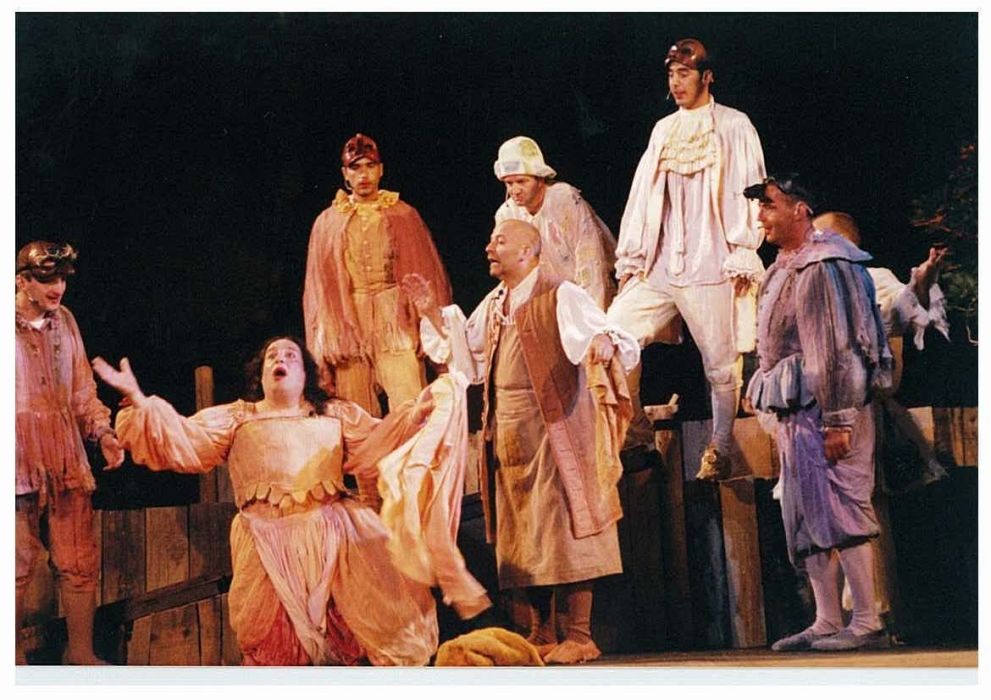
On July 3, 1999, under the direction of Orlando Forioso, A Filetta dared
the theatrical engagement with Don Ghjuvanni in Commedia dell’
arte,
comedy full of humor written with Marcellu Acquaviva on a
music by Bruno Coulais. This show given in the moat of the Fort
Charlet in
opening of Festivoce 99 brings together the six singers of A Filetta in
the role of a
troupe of traveling comedians, Italian actors from the association
Ars Nova,
as well as Fernando Panullo, Marcello Colasurdo, Marie Kobayashi and
Orlando Forioso in
the role of an innkeeper. The scenography is provided by Toni
Casalonga, which creates an atmosphere reminiscent of a Corsican village in the 15th century
century.

This collaboration with Bruno Coulais and Orlando Forioso continued in 2002 with Il Gioco di Robin e Marion, a very loose adaptation (in Italian) of the Robin Hood legend. The plot of this opera draws from the myths of childhood: Princess Marion, held captive by the dreadful Sheriff of Nottingham, hopes that Robin—her beloved and a defender of the downtrodden—will come to set her free. The world is dreamlike: the princess is confined within a large birdcage, and the castle transforms into a forest...

The work, commissioned by ADEM 06, is performed by the Cannes Orchestra under the direction
of Alain Joutard, featuring opera singers Marie Kobayashi and
Jean-François
Ercolani, along with a choir of 400 children from schools in Corsica.
For
Alain Joutard, this project is
"the most effective way to introduce children to music in its
fullest range—from unison to polyphony—through a style that is
rooted in folk traditions, yet lyrical, cinematic, rich, and
open—much like its composer." The production, which includes sets and costumes
created by Toni and Jérôme Casalonga, was first presented
on May 24, 25, and 26, 2002, at the Théâtre de Nice;
on June 8 and 9, 2002, at the
Palais des Festivals in Cannes; and on June 15 in Le Cannet. It was later restaged at the
Municipal Opera
of Bastia on May 9 and 10, 2003.
A musical excerpt, L’Aria,
can be heard in Si di mè,
and the entire production has been distributed by
France 3 Corsica


In 2005, A Filetta composed the music for "Fantastica, the Grammar of the Imagination," a play directed by Orlando Forioso and based on texts by Gianni Rodari. This production, performed several times by children from Calvi, was intended to close the 17th Polyphonic Encounters (Rencontres Polyphoniques). Unfortunately, bad weather prevented the show from being presented outdoors. A Filetta performed the songs inside the Cathedral, without the actors. This hilarious production is set to be presented again in Calvi in 2007 and recorded.
Marco Polo
In early 2006, A Filetta will once again join forces with Bruno Coulais and Orlando Forioso for Marco Polo—an opera dedicated to the travels of Marco Polo, with a libretto by Orlando Forioso and music by Bruno Coulais.
Marco Polo, Opera of the Invisible Journey is an opera in the classical sense of the term—that is, a meeting of music and theater, which—whether together or in turn— will tell a story.
“Today, the world seems small to us, but there was once a time—a time beyond time—when everyone was searching for space,” says Marco Polo—a Marco Polo who does not travel to gain knowledge, but rather to lose himself, to become invisible, just as the men he seeks are invisible. It is a performance dedicated to the sounds of encounter, to the wonder of the “other,” to the sensuality of travel, and to the act of losing oneself in visions too extravagant to be anything but true. Our characters act, sing, and dance, while a Western Marco encounters an Eastern Marco—who is making the same journey in the opposite direction. The participation of Guillaume Depardieu enriches this project through his powerful presence as both actor and singer.
This production was presented as a preview at the Théâtre de Bastia in February 2006, before being performed as part of the Venice Biennale on February 23 and 24, 2006.

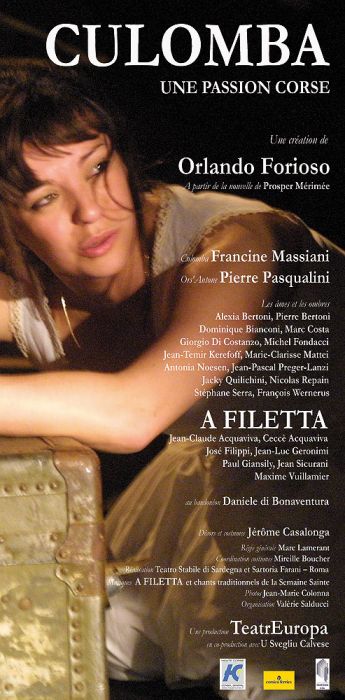
Culomba
In May 2007, Orlando Forioso presented a reimagined version of *Colomba*, drawing inspiration from Greek tragedy. For this production—which will premiere in Bastia on May 5, 2007—Orlando combines theater, recitative, and song, weaving together multiple languages—French, English, Italian, and Latin—throughout this grand, popular spectacle.
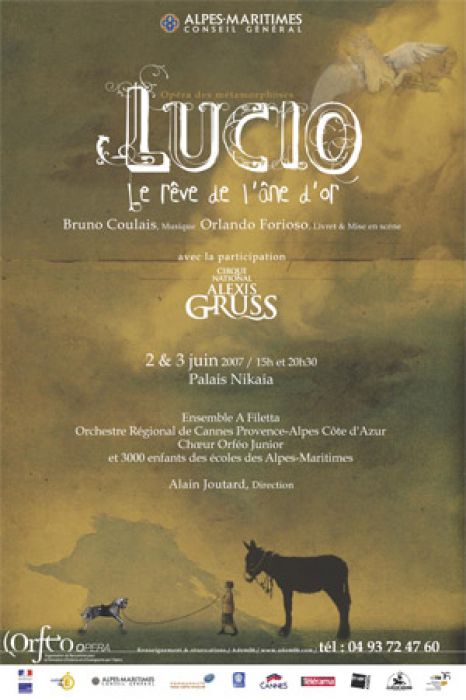
The collaboration with Bruno Coulais and Orlando Forioso continues with "Lucio, the Dream of the Golden Ass"—a new opera for children, created in partnership with ADEM 06, the Cannes Orchestra, and the Gruss Circus. This opera was presented at the Nikaia in Nice in June 2007.
Pessoassion
In 2009, Helmut Bürgel, artistic director of the Stimmen Voices festival in Lörrach (Germany), commissioned Jean-Claude Acquaviva to translate three texts by Fernando Pessoa into Corsican and set them to music.
This new vocal work—a tribute to the poet from Lisbon—was presented during the festival in July 2009. Also involved in the creation of this piece, under the direction of Marion Schmidt-Kumke, were Joana Aderi—a young Swiss musician who has notably set other poems by Pessoa to music (using electronic elements!)—as well as German actor Peter Schröder and photographer Torsten Warmuth.

Sintinelli
In 2020, Laurent Simonpoli, Frédéric Antonpietri and Armand Luciani created Sintinelli in Bastia. The singers of A Filetta sing and act.
The dance : "In memoriam", "Apocrifu", "Puz/zle"
In memoriam
On December 26, 2004, A Filetta also participated in the Monte Carlo à the creation of the ballet «In Memoriam» by Sidi Larbi Cherkaoui. Absence, presence, roots, past, present: the ballet, which turns around these themes, he was inspiredé by the voices of A Filetta.
"When I began thinking about the music for this ballet,
I reflected on who I would dream of
collaborating with. It was A Filetta. I had already been familiar
with their music for four years, and I had a very, very, very
strong desire to one day create something based on it."
"In one of my previous productions, we were working with
very ancient
polyphonic singing, dating back to the 10th and 13th centuries.
For our warm-ups, we would always play the same CD:
'Intantu' by A Filetta."
"After that, I sought out all their other albums, followed
their work, and attended their concerts."
"It is music that
touches me deeply, and I have built my own little narrative
around it."

Crédit photo : Franz Chavaroche
"We are happy that Sidi Larbi reached out to us, as it is a new adventure," says Jean-Claude Acquaviva. "We have accomplished many things across a wide range of fields, but—with the exception of Medea, which blends singing, theater, and dance—we had never before taken part in a ballet. We were surprised and moved to see how well Sidi Larbi grasped what happens between us when we sing. His choreography truly touched us. Our songs, rooted in a Christian and liturgical tradition—expressing passion and pain—are translated into dance with an astonishing aesthetic."
Excerpts from this production will be presented once again in Monaco on August 12 and 13, 2006. Jean-Claude shared with us on this occasion, his admiration
for the
choreographer—who is also a singer and musician—saying: "He knows
all our
songs by heart; when we were rehearsing, we sang U
Sipolcru half a tone higher than the version on the record. Well,
he
noticed it and asked us to do it just like on the record! Sometimes,
he
sings a terza with us..."
The result of this encounter, full of
beauty,
emotion, and grace, is a
resounding success.

Crédit photo : Laurent Philippe
And in 2007, for Apocrifu, his first creation at the Théâtre de la Monnaie in Brussels, Sidi Larbi Cherkaoui once again called upon his friends from A Filetta.
Apocrifu


Puz/zle
On July 14, 2012, Sidi Larbi Cherkaoui was in Avignon for a new project: Puz/zle.
In Puz/zle, Sidi Larbi Cherkaoui revisits—in a more abstract way—the concepts of plurality and diversity rooted in our thought processes, as well as the related question of how things intertwine to create a new, distinct identity (much like a puzzle). Sidi Larbi Cherkaoui seeks to understand why some connections succeed in forming an organic whole, while others fail. He also questions whether such failure is truly a "misfire," or if it exists solely within our own perception of order and disorder.
He therefore strives to question the apparent importance of order and linearity, and to discover whether there is more than one way to solve a puzzle, tell a story, or experience a moment.
Sidi Larbi Cherkaoui seeks to explore and shed light on the puzzles hidden within human relationships—whether emotional, intellectual, or sexual—as well as within the morphology of the body and the intangible, such as music. Music often draws from multiple traditions and diverse sources; for instance, a Spanish liturgical composition may have Arabic roots, long buried in the sands of time. Accompanied on stage by the Corsican polyphonic ensemble A Filetta (his collaborators on Apocrifu and In Memoriam), Lebanese singer Fadia Tomb El-Hage (previously seen in Origine), and Japanese percussionist and flutist Kazunari Abe, Sidi Larbi Cherkaoui examines how a song or composition can emerge from several sources simultaneously—religious and secular, Christian and Muslim, and so on. He also reflects on the fact that the traditions we so readily categorize as "Western" or "Eastern" are far less clearly defined or unambiguous than one might assume. In doing so, the choreographer pays tribute to the exquisite imperfection that gives substance to our lives and our planet.

(see the page dedicated to Sidi Larbi Cherkaoui)
Ritrattu
Dance again with "Ritrattu," presented in 2021 with the island-based company Studidanza.
And Medea, once again...
In February 2005, the group brought a long-held project to fruition: recording the complete set of choruses composed in 1997 for Medea. The Medea choruses were presented in Paris as part of the "Nuit Blanche" event on October 1, 2005, in the Louvre’s Cour Marly. The album was released in June 2006.


An Encounter with Danyel Waro
Embracing "maloya"—the music of slaves and ceremonial rituals—Danyel Waro (born in 1955) sings of his love for this land, his home, and all those who dwell there. He also gives voice to his anger regarding the abuses of the past and the inequalities of the present. Through words that dance—words that "resonate, heal, and unsettle"—he expresses the passionate indignation of those who seek recognition. It is in the Creole of his island, conveyed through the deeply moving warmth of his generous voice, that he channels both ardor and fury.
Similarly, while the ensemble A Filetta may occasionally venture into Italian, Georgian, or Latin, it is the Corsican language that truly lives at the heart of their songs. Like Danyel Waro, Jean-Claude Acquaviva—who is ten years his junior—places his faith in words, their rhythms, and their cadences. For both men, the goal is not merely to "preserve" a tradition—and certainly not to become confined by it—but rather to keep it alive.
This is why the Rencontres des Chants Polyphoniques de Calvi (Calvi Polyphonic Singing Encounters) were established in 1989, where groups of all nationalities and musical backgrounds come together—a setting in which Danyel Waro and Jean-Claude Acquaviva first met and recognized a kindred spirit in one another. It was also in 1989 that the Africolor Festival was born. For their twentieth edition in 2008, the two festivals decided to bring these two artists and their respective ensembles together.
Following this initial encounter, and after several concerts in France, across Europe, and on Réunion Island, it became clear that this creative project deserved a sequel: beyond the delight of the first meeting, there was a desire to experience the joy of reuniting and reaching a new level of depth.
Consequently, the departmental theaters of Réunion decided to host the project for a residency in late September 2011. This led to the creation of an entirely new show, titled "Island Polyphonies" (*Polyphonies insulaires*).
This work focused, in particular, on the dialogue—not only possible but truly warm—between two so-called "minority" languages (Corsican and Creole). Both the *Maloya* of Danyel Waro and the polyphonic singing of A Filetta have always placed paramount importance on the text—its quality, its musicality, and the imagery it evokes.
Below is the text I wrote for the magazine "Fora!":
When Corsica and Reunion meet: A Filetta and Danyèl Waro
Encounters play an essential role in the life of the group A Filetta. Even before their pivotal collaborations with the likes of Bruno Coulais, Jean-Yves Lazennec, Orlando Forioso, Akhenaton, and Sidi Larbi Cherkaoui, the group from the Balagne region had, in a sense, institutionalized the very principle of such encounters by establishing the Rencontres polyphoniques de Calvi (Polyphonic Encounters of Calvi). It was, in fact, there in 2003 that the first meeting took place between A Filetta and the singer and poet from Réunion, Danyèl Waro. Captivated, Jean-Claude Acquaviva and his fellow members invited the singer back in 2008 for the 20th edition of the Rencontres, with the intention of also creating new work together. This collaboration continued through several concerts in Germany, Slovenia, and France, and was set to extend into early 2010 with a tour in Réunion.
On November 13, 2009, I was in Bonneuil-sur-Marne to attend a concert by A Filetta and Danyèl Waro, organized as part of the Africolor festival. Corsican polyphony and the maloya music of Réunion might seem worlds apart, but this seemingly unlikely musical encounter quickly proved to be fascinating. The men of A Filetta brought their expertise in vocal arrangement and harmony to Danyèl, while Danyèl contributed his own lyrics and rhythms.
Danyèl, with his striking, flamboyant hair, opened the concert with two rhythmically driven, percussion-heavy tracks. Then, the seven Corsican singers took the stage and began to perform L'Invitu, from their work Médée. What could be further removed from the maloya tradition than this ancient poem? Yet, the contrast soon faded when the passage "Ribombinu puru i scacani" was revisited with the addition of percussion—the little refrain lending itself perfectly to rhythm and dance. Each side told the story of its own island, while the other listened and provided accompaniment.
A particularly moving moment was the exchange between A paghjella di l’impiccati and a blues-inflected song performed by Danyèl. Though the styles are distinct, the emotions blended together beautifully. A monody sung by Jean-Luc, joined by Danyèl—Meditate, accompanied by the kayamm and bob—followed by dance and trance, with tracks like Po mwin Bondyé and Adekalom… The joy the musicians feel in being together is palpable—and infectious! The audience rewards them with a long ovation. For a final encore, Danyèl begins to sing… A merula. A sublime concert, brimming with immense energy and intensity: a true encounter, in every sense of the word.
A musical collaboration could never succeed if it were merely the brainchild of a record label. In this instance—as is always the case with A Filetta—it is the human connection that takes precedence. Both groups share an uncompromising stance, rejecting commercial strategies and maintaining a profound consistency between their personal values and their artistic message.
While Acquaviva and A Filetta were certainly drawn to the voice and music of Danyèl Waro, they were, above all, captivated by his personality. In his Creole lyrics, Waro sings of his love for his homeland and its people, while also expressing his anger toward the abuses of the past and the injustices of the present.
Danyèl Waro and A Filetta thus find common ground in their assertion of identity, particularly regarding language and song. Although the histories and circumstances of Corsica and Réunion differ significantly, both islands share a complex and often difficult relationship with the French mainland.
For a long time, both the Creole and Corsican languages were disparaged—treated with contempt by the French establishment and local elites alike. Similarly, polyphonic singing was once viewed with disdain, dismissed as the crude, archaic music of unlettered shepherds—labeled... Dismissed even as "Arab singing," maloya was long suppressed—and at times outright banned—by the French colonial administration. Much like Corsican polyphony before the Riacquistu movement, maloya had all but vanished before being rediscovered and brought back to prominence in the 1970s by singer-songwriters such as Firmin Viry and Danyèl Waro.
Insularity is another common thread, one that shapes a particular way of conceiving the land, the elements, and, above all, one’s relationship with the "Other." In this regard, Waro’s discourse on "bastardness" (*bâtarsité*) aligns perfectly with the convictions held by the members of A Filetta: purity does not exist. A "bastard," in the original sense, is someone who has stepped outside their own community for the sake of love. To be a "bastard" is to embrace a culture of difference and to recognize the need to open up to oneself in order to open up to others. Thus, Waro and A Filetta are in complete agreement when it comes to tradition: it is not a matter of preserving a tradition—much less of becoming confined by it—but rather of keeping it alive by engaging with the world and moving forward.
Activists who have never been beholden to any particular faction, Jean-Claude Acquaviva and Danyèl Waro are, above all, free men—resisters, champions of their own languages, and poets. Their paths are similar: having initially prioritized the essential task of fostering political and cultural awareness and reclaiming their collective memory, both men very early on reached out to the wider world, offering a form of song that knows no borders—yet remains deeply rooted.
Fruit of this meeting, a modified version of Meditate, recorded by Armand Luciani during the concert of A Filetta & Danyel Waro on October 13, 2011, during the Musicales de Bastia.
Jazz !
Paolo Fresu and Daniele Di Bonaventura
In October 2006, "L’Aghja"—a small theater in Ajaccio—celebrated its 20th anniversary. To mark the occasion, its director, Francis Aïqui—a stage director and jazz enthusiast—decided to bring together jazz musicians and Corsican polyphonic singers. Another remarkable encounter took place between the Sardinian trumpeter Paolo Fresu and the Italian bandoneon player Daniele Di Bonaventura. Their initial project, Mistico Mediterraneo, was presented at the Rencontres de Calvi festival and later led to an album, recorded for the ECM label in 2010.
Following this success and dozens of concerts, the group decided to continue their journey together. This new endeavor—a musical and vocal project—explores the intersecting perspectives of two men: both islanders, both exceptional figures who left their mark on the 20th century. One was Aimé Césaire—a writer, poet, and playwright from Martinique—and the other was Jean Nicoli—a teacher and member of the Resistance, who was executed in Bastia in 1943 by the Italian fascist occupiers. What these two men shared was a deep political commitment and a profound humanism—most notably in... ...through their assessment of colonialism.
Voice, trumpet, and bandoneon intertwine once more in "Danse mémoire danse" ("Dance, Memory, Dance"), bringing Corsicans and Italians together to celebrate brilliant thinkers who played a major role in shaping the identity and turbulent history of our respective lands.
We had the good fortune to hear this new repertoire in concert on several occasions (in 2014 in Cologne and at the Rencontres de Calvi, then in 2016 in Le Mans and Rouen), and an album was eventually recorded; produced by DEDA/A Filetta, Tǔk Music/Paolo Fresu, and Daniele Di Bonaventura, it was released early in Corsica in July 2017, followed by a national and international release in October 2018.
Andy Emler
A fresh encounter with jazz—this time, through the work of Andy Emler. Having been a guest at the Rencontres de Calvi in 2017, the pianist returned in 2019 to present a unique fusion of two oral traditions: jazz and Corsican polyphonic singing. This experimental and innovative creation, titled "The Wake-up Call," is a suite composed by Andy Emler for a quartet—featuring his long-time musical collaborators—brought together specifically for this project alongside the voices of the ensemble A Filetta. The group includes Laurent Dehors (bagpipes, clarinet, bass clarinet), Claude Tchamitchian (double bass), and François Verly (percussion).
Another milestone in the journey of A Filetta: to put it very broadly, in Mistico mediterraneo and Danse mémoire danse, the compositions were mostly by Jean-Claude Acquaviva, with the two wonderful musicians Paolo Fresu and Daniele di Bonaventura fitting into the available spaces. Here, it is the jazz musician who composes, and the voices that integrate themselves into the musical universe of Andy Emler.
Presented as a preview at the 2019 Rencontres de Calvi, the work had its official premiere on September 28, 2019, at the Musée des Confluences in Lyon. We were fortunate enough to attend the subsequent concert in Paris at Le Pan Piper on March 13, 2020—just on the eve of the first Covid lockdown. A truly memorable experience!
Conversation(s) between East and West

On one side, the captivating, hushed voice of Fadia Tomb El-Hage; on the other, the voices of A Filetta.
Brought together for the first time by choreographer Sidi Larbi Cherkaoui for his production Puz/zle—presented in 2012 as part of the main program at the Festival d’Avignon—the artists developed this concert version at the request of another festival, the Festival d’Île-de-France.
A cappella singing is presented here in all its purity. Whether secular or sacred, and performed in Corsican, Arabic, or Syriac, these songs bring together two worlds and two musical traditions—an osmosis born of deep, attentive listening and a perfect complementarity between the performers.
While each retains its own distinct character, these conversations open up imaginary spaces that gently take shape through the melismas of the voices and the blending of timbres.
From this encounter emerges a unique symbiosis—a limpid polyphony and a timeless, poetic harmony that unites Corsican and Eastern repertoires in a single, shared impulse.
“A Filetta is a polyphonic group that sings with a single voice; as for Fadia, she alone sings like an entire choir. When you listen to them together, it feels as though you are hearing the whole planet.”
Sidi Larbi Cherkaoui
The strings with Conductus : "Archincanto"
Since 1978, A Filetta has struck a balance between traditional songs and original contemporary compositions.
For some twenty years, the Ensemble Conductus—founded in 1999 by Marcello Fera—has pursued a similar artistic path in Italy, characterized by the originality of its programming and performances, where tradition and modernity converge, and where there is a particular focus on reinterpreting material rooted in folk culture.
Their encounter in 2011 culminated in 2021 at the Rencontres de Calvi, giving rise to a world where contrasts harmonize: the folk-inflected oral tradition championed by A Filetta and the classical string arrangements of Conductus weave a tapestry of entirely new colors. Here, the sacred and the secular, the folk and the learned, are not in opposition, but rather complement one another beautifully.

Return to the opera : « Ulysses »…

In 2018, A Filetta reunited with Orlando Forioso for a new contemporary opera, "Ulysse sans Terre" ("Ulysses Without a Land").
Featuring compositions by Jean-Claude Acquaviva, the production stars Fadia Tomb El-Hage as Penelope, alongside two young Corsican singers:
Diana Saliceti (Calypso) and Lea Antona (Nausicaa).
Drawing from sources ranging from Sophocles and Joyce—as well as Plato, Virgil, and, in more recent times, Giraudoux, Giono, and Kazantzakis—
Orlando presents his own take on the intriguing protagonist of the Odyssey: Ulysses. Is he a hero? A warrior?
A murderer? A braggart? A man of endless cunning and many women? Or... a migrant?
… And to theatre with « Œdipe Roi »

In November 2019, A Filetta took part in the creation of "Oedipus Rex / Fear Is Not a Worldview," directed by Noël Casale and based on the text by Sophocles. The production featured both amateur and professional actors, accompanied by the singing of A Filetta—a work that was the culmination of a year spent on the writing process.
Moving constantly between Thebes in the past and Bastia in the present, this reinterpretation of Sophocles’ tragedy weaves together—with subtlety and sensitivity—theater, song, and both the Corsican and French languages. It also powerfully interrogates the themes of fear and the figure of the "outsider"—elements often exploited during political crises, both in the past and today...
People from Bastia have gathered today to speak of Thebes in times past—a city teetering on the brink of chaos. An unsettling, definitive air hangs over the scene; one senses a vague, looming threat. Voices are hushed. Oedipus questions incessantly, driven by the tension between what he increasingly senses—and eventually discovers— and what he desperately hopes to see proven wrong. We are no longer witnessing merely the struggle of one man, but the extraordinary and profoundly anxious effort of an entire population attempting to escape the worst...
The project to stage *Oedipus Rex* through the lens of Corsican society is one that author, director, and actor Noël Casale has long carried with him. In November 2018, he began a theatrical research workshop with residents of Bastia to explore these social, political, and cultural questions. The project took shape with actor Yann Boudaud—a singular Oedipus—and the polyphonic ensemble A Filetta, a magnificent bridge between the world of the past and the present, whose singing contributes to revealing the beauty of the world.
An Encounter with Kiya Tabassian
Having appeared at the Rencontres festival in 2019 (alongside Ablaye Cissoko) with his ensemble, Constantinople, Kiya Tabassian returned in 2020 for a collaboration with A Filetta. Clair-obscur is an absolutely enchanting, poetic, and melodic suite.
In this shared repertoire, the two groups join forces to create a soundscape where light and shadow dance together. The Corsican polyphony of A Filetta, combined with Persian vocal traditions and classical music—orchestrated by Kiya Tabassian—come together for a deeply moving concert. This collaboration continued with further performances in Paris, Canada, and once again in Calvi, eventually leading to the release of an album: "Clair-Obscur," published in September 2026.

The "Lumio" project
The 32nd edition of the "Polyphonic Singing Encounters" in Calvi gave rise to a collaboration that is sure to become a landmark: a meeting between A Filetta—one of the foremost ensembles dedicated to the creation of polyphonic music—and the hypnotic singer Abdullah Miniawy, accompanied by Peter Corser on the saxophone.
An incredible alchemy emerged between artists whose respective journeys reveal a deep-seated curiosity and a desire to imbue their music with all the vibrant colors of cultural exchange. It is a remarkable osmosis, where voices—seemingly echoing from the dawn of time—weave new dreams and new sonic landscapes at the crossroads of the eternal Mediterranean, while simultaneously resonating with the echoes of ancient civilizations from the heart of the Orient. These breaths and timbres feel as though they found one another and intertwined across mountains and deserts, reaching back to time immemorial…
From this moment—which still resonates within our hearts—arose a desire to go further, to bring forth a new kind of fusion, born as much from acts of letting go as from acts of discovery; a new song, visceral and generous, in which each individual exists because everyone else embraces and affirms them.
This project came to an abrupt end with a final concert in Paris on January 25, 2025—a performance that was, fortunately, recorded and subsequently broadcast by Radio France.

Co-production : Festival Les Traversées - Abbaye de Noirlac, Centre Culturel de Rencontre, Bonlieu - Scène Nationale Annecy, Cité de la Musique de Marseille, Théâtre de Cornouaille – Scène Nationale de Quimper, Maison de la Culture de Bourges - Scène Nationale, Rencontres de Chants Polyphoniques de Calvi, Centre Culturel Natale Rochiccioli – Cargese, Théâtre de Propriano
A Return to Song with "I Balconi"
October 2023 saw the release of "I Balconi" ("The Balconies")—a nod to those extensions of our homes, serving as a first step, an initial gaze beyond our enclosed and circumscribed worlds. Balconies: places from which we discover that we are not alone…
The lyrics speak, with simple directness, of our shared destiny and common humanity—of love, death, and resilience; of the paths we have carved, the seas of our utopias, the journeys of our greatness, and the bitterness of our own finitude…
This collection of polyphonic songs treats voices as instruments in the service of the lyrics. A single guitar—played with meticulous craft yet marked by a profound sense of restraint—helps shape the work into the form of a song. The record invites the listener, in an atmosphere of deep intimacy, to enter the soft, hushed world of a repertoire born during the unique and unprecedented period of the lockdown.
Composition: Jean-Claude Acquaviva
Authors: Marcel Acquaviva, Jean-Claude Acquaviva, Petru Santucci, Laurent Gaudé
More information -----> here.
Yet more encounters, other projects...
Examples include Corsic'Ard—a new collaboration with Daniele Di Bonaventura—as well as a project with Richard Galliano, a collaboration with Ensemble Resonanz and composer Catherine Lamb, and an encounter with the Korean group Liquid Sound...

Aghju sunniatu qualchi volta è più à un antivistu mondu senza
strade. Alta felicitai? (I have sometimes dreamed—and even more so, envisioned—a world without
roads. Supreme happiness?)
The Composition of the Group
What are the foundations for recruiting members to the group? A passion for this form of expression, of course; the quality of one’s voice, naturally; but also—perhaps even above all else—something indefinable: a blend of solid friendship and a profound respect for one another.
Polyphony is the meeting of different voices in perfect harmony. I do not claim that we always reach this goal toward which we strive. But I am certain that, in order to achieve it, a perfect osmosis among all the participants is essential. ” (Jean Sicurani)
“It is a form of singing in which each person is fully responsible for what they contribute, while at the same time being entirely dependent upon—and an integral part of—what others contribute. Without a very strong and distinctive bond between us, no lasting, high-quality result can be achieved.” (Jean-Claude Acquaviva)
This exceptionally strong bond is both utilized and reinforced as A Filetta
collectively explores musical arrangements for traditional songs, as well as
for original compositions. The latter are based on texts written by
Jean-Claude Acquaviva, his brother Marcellu, or other island authors—
whether from the past (Filippini) or the present day (Rinatu Coti,
Ghjuvan-Teramu Rocchi). Rooted in an ancestral culture based on oral
tradition, these works—set to music by Jean-Claude—are never committed
to written scores. Instead, the lyrics and melodic lines are learned and
retained entirely “by ear.” by each member of the group
before they work on and interpret them together: each one
listening attentively to the others, with no one seeking to dominate
the whole—all striving toward the shared pursuit of perfect
harmony among
their voices.

Paul Giansily, François Aragni et Jean-Claude Acquaviva. Photo : Didier D. Daarwin
The list of all those (forty-five, unless I'm mistaken) who participated in the A Filetta adventure:
Founding members:
Michel Frassati,
Tumasgiu Nami,
Dédé Nobili,
Jean-Claude Acquaviva,
Jean Sicurani,
Then, in alphabetical order:
François (Ceccè) Acquaviva,
Jean Antonelli,
François Aragni,
Daniel Berti,
Pierre Bertoni,
Jean-Do Bianco,
Stéphane Casalta,
Petru Antò Casta,
François Croce,
Natale Ferricelli,
José Filippi,
Eric Fino,
Jean Yves Franceschi,
Jean-Luc Geronimi,
Nonce Giacomoni,
Stéphane Giannecchini,
Paul Giansily,
Tony Guidicelli,
Christian Johanenc,
Yves Leccia,
Jef Leschi,
Jean Luciani ,
Christian Magdelene,
Antoine Mariotti,
Philippe Mariotti,
Maxime Merlandi,
Paul Félix Nasica,
Henri Olmeta,
Francis Palmari,
Battì Paoli,
Bernardu Pazzoni,
Jean Marc Pellegri,
Jean Luc Raclot,
Valérie Salducci,
Benedettu Sarocchi,
Stéphane Serra,
Jean Vincent Servetto,
Jean Philippe Tomi,
Félix Travaglini (Felì),
Maxime Vuillamier
Plus four musicians who accompanied the group for
a few years
on the "Una tarra ci hè" tours: Anne-Lise Herrera, Isabelle
Escanez,
Jean Michel Giannelli et Paul-Antoine de Rocca Serra.
The current group (September 2026) is the following: Jean-Claude Acquaviva, composer and spokesperson for group, siconda and terza, Petru Antò Casta, arrived in 2017, siconda and bassu, Jean-Vincent Servetto, siconda and terza, arrived in 2025, François Aragni, who joins the group 2013, siconda and bassu, Paul Giansily, siconda and terza, arrived in 1984, Maxime Vuillamier, bassu (1989), Jean-Do Bianco, bassu (arrived in 2019). To which must be added the omnipresent Valérie Salducci, à both stage manager, lighting designer, administrator...

The group’s integration into local life
A Filetta has always been deeply involved in local life. This is evidenced not only by their collaboration with U Svegliu Calvese on the Passion, the Via Crucis, and the Rencontres Polyphoniques (Polyphonic Encounters), but also by their extensive work within the educational sector—through school workshops and performances such as Il Gioco di Robin e Marion and La Grammaire de l'imagination. Also noteworthy is the project "creazione, canti e incontri" ("creation, songs, and encounters"), carried out in partnership with the "Una Volta" cultural center in Bastia, which focused on educational outreach for children, in collaboration with the group Soledonna.
Whether they are singing the ancient choruses of *Medea* or composing for
Bruno Coulais, the soul of their polyphony is always present.
Heirs to a strong tradition yet engaged with the evolving world,
the ensemble A Filetta is not one of those groups anchored solely in the past.
"With ever-greater rigor, A Filetta—through its concerts
and recordings—establishes a vision that is both ardent and serene,
encompassing the sacred and secular songs that gradually
form its repertoire. Traditional pieces and original compositions intertwine—
hymns to the language and culture of the island, alongside
calls toward other horizons." (Philippe-Jean Catinchi)
And finally, two excerpts from concerts
Between traditions and contemporary creations: treasures of polyphonic songOn Sunday, September 30, 2018, the Swiss radio station RTS—in its program La note bleue, hosted by Yvan Ischer with the regular collaboration of Vincent Zanetti—broadcast excerpts from past concerts by A Filetta.
These include performances recorded on September 22, 2002 (Médée) and September 23, 2007, as part of the Notes d’équinoxe festival in Delémont.
To go further:
Two essential documents retrace the itinerary of A Filetta:
First of all, the exceptional documentary "
Trent'anni pocu, trent'anni assai" produced in 2008 for the magazine "Ghjenti" of France 3 Corse by Cathy Rocchi.
This 78-minute film was published by Harmonia Mundi in a DVD box set also containing a "private concert" à the St Antoine de Calvi oratory, a video bonus of 8 tracks as well as a bonus of 8 audio tracks (more details on page discography).

A small excerpt : A Paghjella di l'Impiccati in the Oratoire of Calvi.
And also my book, "A Filetta, Tradition et ouverture - De la polyphonie corse au chant du monde" published in 2009 by Colonna Editions.
